Every robot, from a welding arm on a car assembly line to a surgical system in an operating room, is only as precise as its control system. The control system is what translates a command into coordinated motion across sensors, actuators, and joints.
A robotic control system processes inputs from the environment, runs them through software algorithms, and sends the right signals to the right actuators at the right time. Get that loop wrong and the robot either misses its target or damages what it’s handling.
The robot control system market is projected to reach $19.9 billion by 2033 (Fact MR), growing at 11.2% CAGR. That growth is driven by demand for higher precision, safer human-robot collaboration, and the expansion of robotics into medical and logistics environments where errors carry serious consequences.
What Are Robotic Control Systems?
A robotic control system is the computational and mechanical architecture that governs how a robot perceives its environment and acts on it.
It handles the full loop: reading sensor data, processing it against a control algorithm, and issuing commands to actuators to produce the desired motion or force.
The quality of that loop determines positional accuracy, response time, and how safely the robot can operate near people or fragile materials.For more on how control systems affect human-robot interaction, see our dedicated guide

Key Components Of Robotic Control Systems
For the robots to function well, three crucial components should work together for the best results. Here are the elements found in robotic control systems.
Controllers
These are also called the Robot’s brains, as they help process data and make decisions. In simple and not-so-complicated robots, microcontrollers handle different tasks, such as motor control and navigation.
But that’s not the case for advanced robots that process extensive data, as they need high-performance controllers.
Sensors
These are the eyes and ears of a robot. According to Straits research, the robotics sensors market is meant to reach $1,166 million by 2031. They help gather data from the environment, which translates into actionable details.
Since there are different sensors, they are used to carry out various tasks. For instance, camera sensor robots assist the robots in mapping their surroundings, whereas microphones assist with carrying the sound. Advanced sensors like tilt can measure slant angles with a horizontal plane reference, often used to detect orientation and inclination.
Actuators
These muscles of a robot are often responsible for its movement. According to Allied Market Research, the actuators market, valued at $13 billion in 2022 will experience a 12% CAGR between 2023 and 2030.
In most cases, they convert energy into physical motion, thus enabling the robot to carry out different tasks, including:
Manipulation: End efforts attached to the robot arm are equipped with objects that apply force and assist in performing different tasks.
Joint movements: The motors control the robot’s joints, thus allowing the arm to grab, manipulate, and reach particular objects.
Bonus Key Component: The Software
A robotic control system needs software that handles the system by providing combination protocols, user interactions, and data management. The right software integrates the different hardware components, making the robot a fully functional system.
Real-time operating systems (RTOS): This offers efficient scheduling and resource management that allows the real-time control of tasks, thus ensuring timely responses to the sensors.
User interface: This allows humans to interact with the robots, monitoring their performance and adjusting the parameters.
Middleware: This helps communicate between software components and allows seamless data exchange and control signal transmission.

Types Of Robot Control Systems
Robot control systems are classified into different categories depending on their nature, ability to perform different tasks, and autonomy level. Here are a couple of standard options:
| Control System Type | Feedback Loop | Best Suited For | Example |
|---|---|---|---|
| Reactive | None (direct stimulus-response) | Fast, unpredictable environments | Insect-inspired robots, obstacle avoidance |
| Open loop | None (pre-programmed commands) | Repetitive, predictable tasks | Conveyor belts, automated sprinklers |
| Closed loop | Yes (sensor feedback corrects errors) | Precision tasks, adaptive behavior | Self-driving vehicles, CNC machining |
| Deliberative | Yes (model-based planning) | Complex decision-making, long-term planning | Surgical robots, autonomous exploration |
Reactive Control System
This type responds directly to the sensory inputs, making those best for some tasks that need quick reflexes, thus adjusting to real-time changes.
The systems don’t have integral models but can still achieve complex behavior by reacting to stimuli. Some reactive control robots are inspect-inspired robots that respond to sudden changes in a complex environment, such as falling items.
Warehouse autonomous mobile robots (AMRs) used by companies like Amazon and Locus Robotics often combine reactive obstacle avoidance with higher-level path planning to navigate dynamic warehouse environments safely.
Benefits
They offer fast response times.
These robots are adaptable to unpredictable environmental issues.
Disadvantages
It is limited to decision-making capabilities.
It is not suitable for long-term planning.
Open Loop Control
These control systems do not use the feedback from the robot’s environment to adjust their tasks. Instead, they rely on pre-defined commands and assume that the surroundings are predictable, meaning they are less accurate.
However, the systems are simple and inexpensive. Some examples of open-loop control systems include conveyor belts and automated sprinklers. An automated sprinkler, for instance, follows a predetermined water distribution schedule, assuming that the garden or law has a uniform shape.
Advantages
They are cheap and easy to install.
They are suitable for repetitive and predictable environments.
Disadvantages
These systems are less adjustable to the changing conditions.
They can be inaccurate at times due to the lack of feedback.
Closed-Loop Control
Closed-loop control incorporates a feedback mechanism to monitor actual robot performance against the desired output.
The sensor reads what the robot is doing, compares it to the target state, and generates an error signal the controller uses to correct the motion in real time. This makes it far more accurate than open-loop control and capable of handling dynamic environments where conditions change mid-task.
Universal Robots cobots are a common example of closed-loop robotic control in manufacturing environments. Their controllers continuously adjust motion using encoder and force feedback so the robot can safely operate near human workers and react to unexpected contact in real time.
The sensors measure the robots’ outputs and compare them to the desired output, thus generating an error signal. Some of the examples are self-driving tendencies. These use cameras and radar sensors to gather real-time data about their surroundings and paths.
Pros
They are more accurate in providing relevant performance.
The robot control systems can deal with complex tasks.
They are easily adjustable to the changes in the environment.
Cons
They are more complicated to design and implement.
You will need additional sensors to operate these control systems smoothly.
Deliberative Control
It generates high-level actions and is best suited for complex decision-making and long-term planning tasks. Such systems have knowledge representation and optimization techniques that assist in achieving some goals.
Some examples of deliberate control include robotic surgeons used in preoperative planning as they offer real-time data, thus allowing surgeries to be performed effectively, and autonomous exploration robots.
Surgical robotics systems such as the da Vinci Surgical System layer deliberative planning with real-time force and motion control, allowing surgeons to execute highly precise movements while filtering hand tremor and maintaining sub-millimeter positioning accuracy.
Different types of robots require different control architectures. A fixed industrial arm typically uses closed-loop control, while an autonomous mobile robot may layer reactive and deliberative systems.
Advantages
They can help with complex planning.
These control systems are ideal for long-term tests.
They can easily handle uncertainties.
Disadvantages
It is demanding.
You will need accurate planning capabilities.
Types Of Industrial Control Systems
Whether you need to upgrade your cobots or find the most compact force torque and sensor, or get a robotics kit, there will be something that works well for your firm. Here are different types of industrial control systems, including:
Programmable logic controllers (PLCs): These monitor inputs and outputs, thus executing orders based on previous instructions.
Distributed control systems (DCS): While PCLs focus on discrete control, DCS are crucial for providing a continuous process, such as in oil refinery and energy.
Human-machine interfaces (HMIs) are industrial systems that let people interact with robots.
Building management system (BMS): These systems are ideal for buildings and residential places such as hospitals or commercial buildings. That allows the building’s lights, security systems, HVAC, and other gadgets to operate well.
Conclusion
The control system is the layer that determines whether a robot is useful or unreliable.
Choosing the right type (reactive, open-loop, closed-loop, or deliberative) depends on the task environment, required precision, and how much real-time adaptation the application demands.
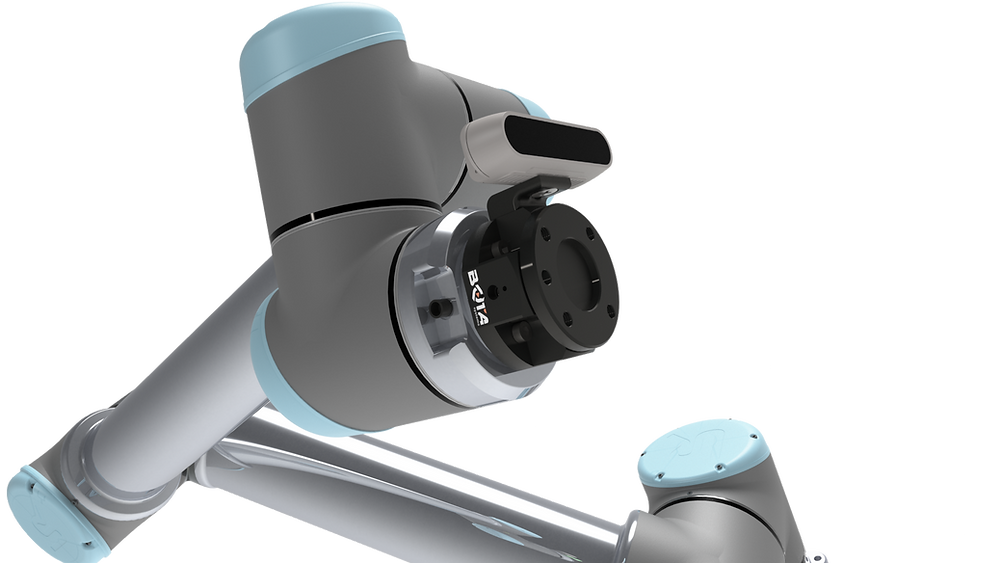
At the sensing layer, force-torque feedback is what closes the loop on physical interaction. A closed-loop control system can only correct motion errors it can measure.
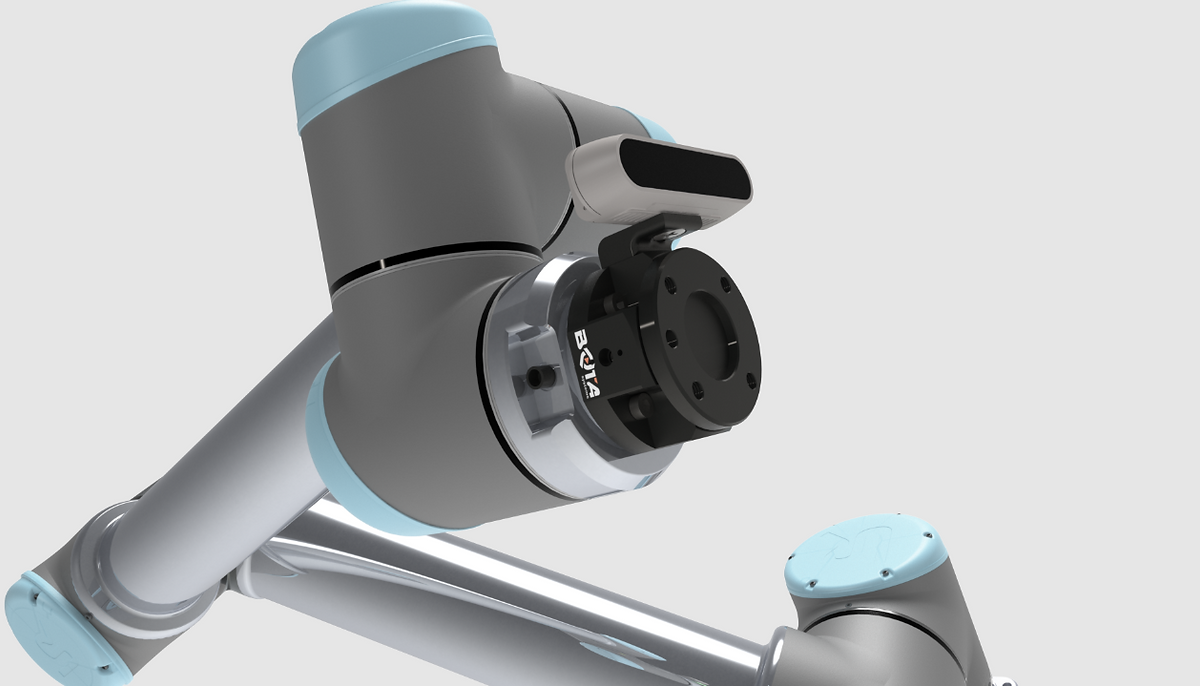
In assembly, surgical robotics, and human-robot collaboration, a 6-axis force-torque sensor gives the control system the data it needs to handle contact forces accurately, not just position.
Bota Systems designs force-torque sensors and joint torque sensors built to integrate directly into robotic control architectures. If you’re specifying sensors for a control system that needs precise contact feedback, Get in touch.
Frequently Asked Questions
What is the difference between open-loop and closed-loop control in robotics?
An open-loop control system executes pre-programmed commands without checking whether the robot actually reached the desired state. A closed-loop system uses sensor feedback to compare actual output to the target and correct any error in real time.
Closed-loop control is more accurate but more complex and expensive. Open-loop is adequate for simple, repetitive tasks in predictable environments.
What are the main components of a robotic control system?
The three core components are: controllers (the processing unit that executes logic and sends commands), sensors (which feed environmental data back to the controller), and actuators (which convert controller commands into physical motion).
Software ties them together via real-time operating systems, middleware, and user interface layers.
What is a PLC in robotics?
A Programmable Logic Controller (PLC) is a ruggedized industrial computer that monitors inputs and executes control logic to operate actuators and machinery. In robotics, PLCs are common in fixed industrial automation (welding lines, conveyor systems) where the control task is discrete, well-defined, and requires high reliability.
More complex robots with adaptive behavior typically use higher-level controllers running ROS or similar middleware.
How does force-torque sensing improve robotic control systems?
Force-torque sensors add a physical feedback layer that position sensors alone can’t provide. In a closed-loop system, a 6-axis force-torque sensor lets the controller measure the actual forces and torques the robot’s end-effector is experiencing during contact.
This is what enables precise assembly (detecting part insertion resistance), safe human-robot collaboration (detecting unexpected contact), and adaptive manipulation (adjusting grip force to object fragility).