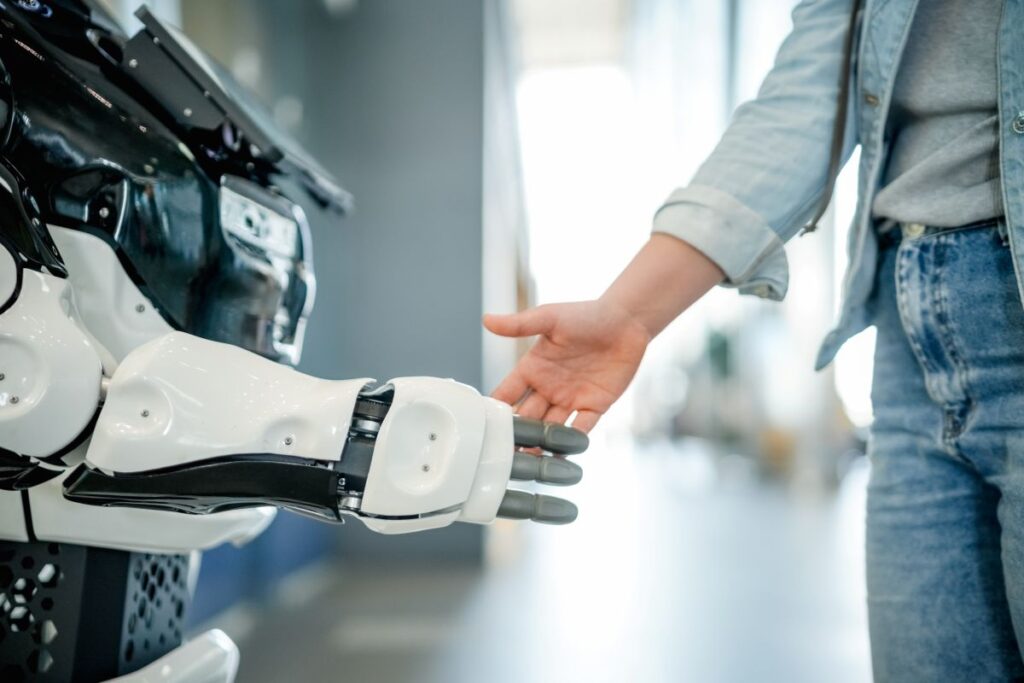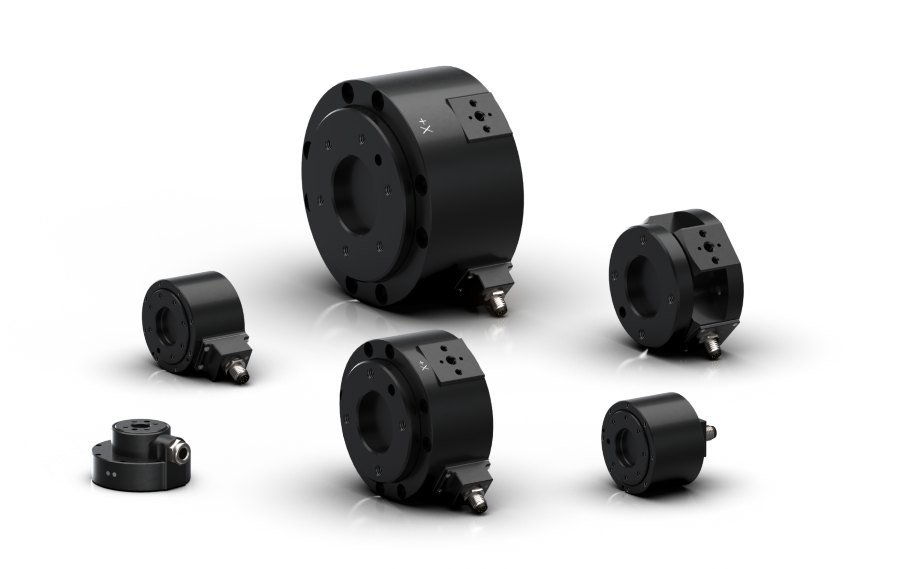
Force sensing and force control are increasingly becoming an essential part of robotic solutions. This is mainly driven by the fact that robots are used in more unstructured environments, are required to perform more demanding tasks, and should be able to co-exist with human collaborators.
The growth of the collaborative robots (or short Cobots) market already shows the increasing demand for such sensitive robots.
Force sensitivity can be achieved using joint torque sensors, tactile skins, or end-of-arm tooling equipped with wrist force-torque (FT) sensors. Cobots are typically equipped with at least one of these sensor types.
In addition to cobots, FT sensors and force control can also be integrated into industrial robots, enabling more advanced and efficient methods of process automation.
Watch the video showcasing a Plug & Play robotic finishing solution featuring a LaxONE 6-axis force-torque sensor and a Stäubli 6-axis industrial robot:
What is Force Control?
Traditional industrial robots are great machines that are optimized for repeatability and accuracy. They can do the same motion over and over again with high speed and reliability due to their high stiffness.
However, these robots are not inherently designed for flexibility and adaptability. As a result, they often require a large number of repetitions to be cost-effective, and their motions can be complex to program.
That said, industrial robots can become adaptive through force control. Force control involves using the output of a force-torque sensor (also known as a load cell) in a feedback loop to adjust the robot’s motion dynamically.
Instead of following a fixed trajectory, the robot adapts its behavior based on sensed forces. For example, it can follow an unknown surface while maintaining a consistent contact force. In essence, force control regulates the physical interaction between the robot manipulator and its environment.
A common force control approach is admittance control, which translates force or torque measurements into position or velocity commands for the robot. Most major robot brands offer this feature in their controllers, allowing for easy integration of force-torque sensors, whether in the joint space or at the end-effector.
Traditionally, industrial manipulators were limited to tasks based on position control and predefined trajectories. With force control, it’s now possible to unlock new robotic capabilities, enabling tasks that were once too complex or delicate.
These include polishing irregular surfaces, assembling tightly fitted parts, and performing interactive tasks in unstructured environments.
What are the Benefits of Multi-axis Sensors in Industrial Automation?
A 6-axis force torque sensor mounted to the robot wrist is an easy and affordable way to realize force control with a short implementation time.
Especially sensors with integrated electronics are simple to install and can be directly connected to the robot’s communication bus or controller.
Using a sensor that is robust, compact, and stiff allows for various applications and makes it possible to keep it attached to the robot even while not directly in use.
The flexibility of use and ease of installation quickly lead to a positive Return on Investment (ROI). In addition to automating labor-intensive and hazardous tasks such as grinding, this approach also enables more consistent processes while allowing for simultaneous monitoring.
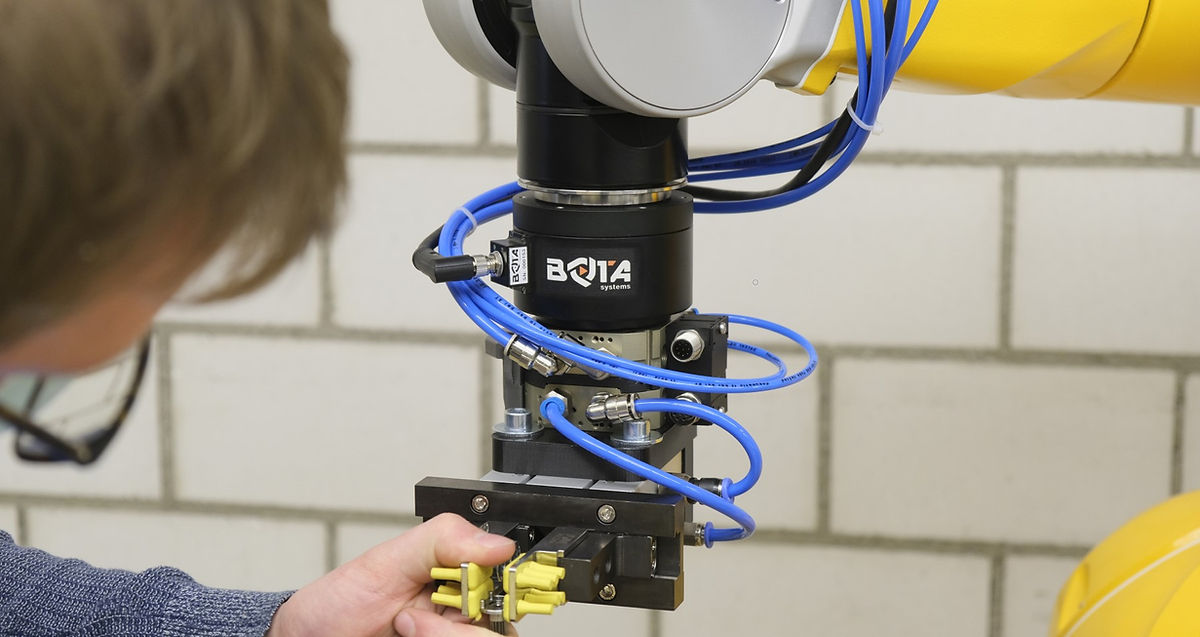
Using a full 6-axis force-torque sensor provides flexibility, even if not all axes are required simultaneously for a given application.
For example, in robotic surface polishing, force control is used to regulate the force perpendicular to the tool and ensure proper alignment with the surface. Meanwhile, the robot follows a pre-programmed or recorded position trajectory in the remaining directions. As a result, many applications benefit from a hybrid force/position control strategy.
Despite only certain axes being actively controlled, the process forces can still be monitored across all directions.
This monitoring helps prevent manufacturing errors and ensures a consistent surface finishing quality, which is essential in high-precision or high-consistency tasks.
While not every industrial robot can be transformed into a collaborative robot (cobot), they can still become more adaptive to dynamic and complex environments.
With force sensing, robots gain the ability to respond to disturbances and uncertainties in real time. This enables them to detect contact along the tool path and provides an intuitive method for teaching new tasks or modifying existing waypoints.
What are the Limitations of Multi-axis Force Torque Sensors in Industrial Automation?
Of course, there are limitations to using force-torque sensors to make robots more adaptive, which should be considered when planning to automate a process through force control.
Force control is a reactive approach, and the robot must respond quickly enough to minimize force errors. This becomes especially challenging when working with stiff materials, where force peaks can occur rapidly.
A robot arm can only achieve a finite acceleration due to its mass and limited torque capabilities. To mitigate force spikes in an application, the tool velocity can be reduced, allowing the robot to respond in a timely manner.
Therefore, it is crucial to distinguish between motion sequences that require force control (which may need to be slowed down) and high-speed motion sequences without contact, in order to optimize the application speed.
Force control is a broad and often complex topic, which can hinder the successful realization of projects.
However, we believe it shouldn’t be this way, and we anticipate that in the future, integrating force control will be as simple as integrating classical position control applications.
Fortunately, many robot brands already offer force control packages that simplify the integration process. Bota Systems has extensive experience in force control and is committed to providing solutions that are as easy to integrate as possible.
What are the Applications of Force Torque sensors?
Maybe you are not aware of it, but the majority of tasks performed by humans rely on our force sensing.
As robots are increasingly expected to replicate these tasks, they need a similar sense of touch. Below are some common applications that benefit from force-torque sensors and force control.
Surface Finishing
Finishing applications like material removal, polishing, deburring, or deflashing are some of the dirtiest and most exhausting tasks in manufacturing.
By using force torque sensors and direct force control, it is possible to easily automate these challenging processes. The sensor feedback provides the flexibility and adaptiveness required even for complex shapes and enables a consistently high surface quality.
Key Benefits:
Ensures better product quality with consistent and controlled force application
Addresses shortage of highly skilled worker
Reduces risk of injuries
Enables faster finishing
Generates less wear on consumables for finishing applications
Assembly
Sensorized robots can perform assembly processes with high repeatability, even when dealing with tight tolerances.
By using force feedback during insertion, flexibility, reliability, and robustness can be significantly improved. The insertion can be executed with just the right amount of force, preventing damage to parts and minimizing downtime on the production line.
Key Benefits:
No need for an expensive test bench or assembly table with high tolerances.
No damage to the surfaces of high-tolerance, stiff metal parts.
Quality-controlled assembly.
Hand Guidance and Teach-in
Programming a robot is often time-consuming and complex due to the coding involved.
Flexibility in production can be significantly enhanced by integrating an intuitive, code-free method for recording waypoints and teaching positions.
This reduces programming effort and enables automation even for tasks with only a few repetition cycles. Adding a force-torque sensor at the wrist further enhances the robot’s safety, accuracy, and reliability, making it suitable for collaborative applications.
Key Benefits:
Reduce programming time from hours to seconds
Intuitive, no-code programming
Easily reprogram and correct errors for greater flexibility
Telemanipulation & Rehabilitation Devices
Telemanipulated medical robots and rehabilitation devices demand the highest performance from force-torque sensors.
These applications require sensors with high signal bandwidth, exceptional accuracy, and high sensitivity to enable precise, high-fidelity force feedback—either directly at the robot or remotely.
Additionally, the sensors must be compact and lightweight for seamless integration into the device structure
.
Key Benefits:
Reduced medical risks
Enhanced sense of security for the patient
Shorter patient recovery times
Lower cost per procedure
In addition, force control is used, often along with other sensors, for product testing, process monitoring, and object identification.
Conclusion
Robots need to be smarter, more flexible, and safer—challenges that force control is specifically designed to address.
Force control plays a fundamental role in enabling robotic systems to exhibit human-like, robust, and versatile behavior in dynamic, unstructured environments. It allows robots to respond intelligently to unforeseen situations and significantly enhances human-robot interaction.
Bota Systems force torque sensors are specifically designed for robotic applications and are accurate, robust, compatible, and easy to integrate.
If your application is unique or you are still not sure of the best solution for you, we recommended contacting us, and we will help pair you with the right solution.