Have you ever wondered how your smartphone detects your touch or how robots determine the right amount of pressure to apply when handling objects? The answer lies in force transducers!
A force transducer is a device that measures mechanical forces, acting as a bridge between machines and the physical world.
These innovative tools convert mechanical force into electrical signals, allowing us to measure, analyze, and interact with our surroundings effectively.
From the gentle tap on a touchscreen to the immense weight of a building, force transducers play a crucial role across numerous industries.
What is a Force Transducer and How Does it Work?
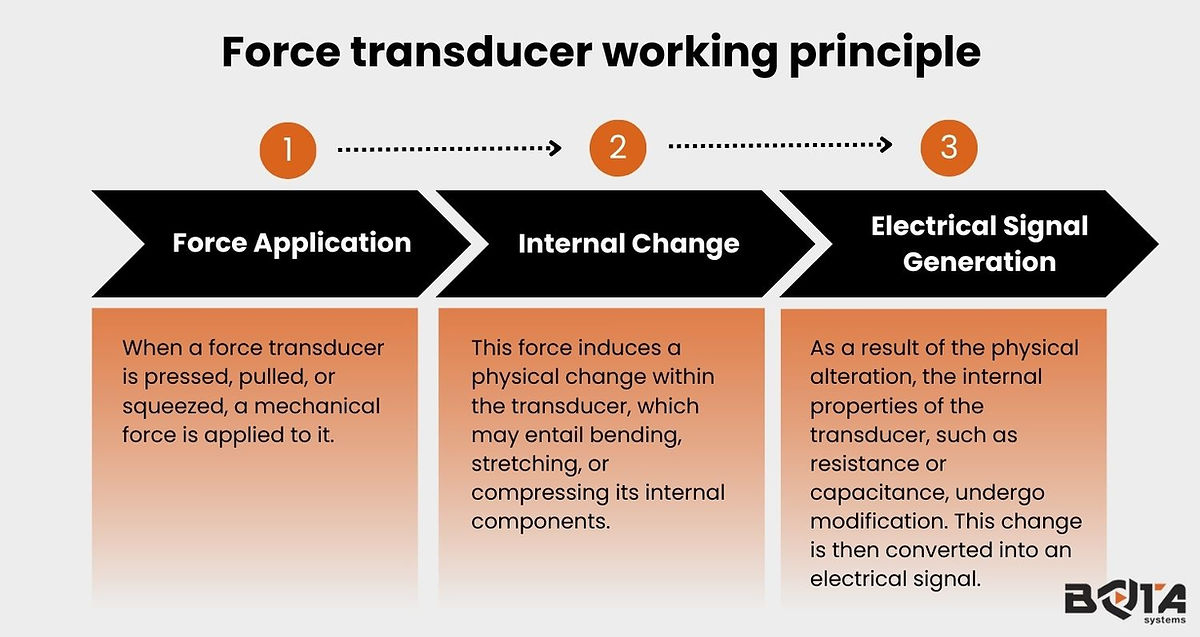
Force transducer working principle
Force transducers function by converting mechanical force into an electrical signal. This conversion occurs through different methods, but the fundamental principle remains the same: detecting force and translating it into measurable data.
Types of Force Transducers
Force transducers employ various technologies to transform mechanical force into electrical signals. Below are some of the most widely used methods:
Strain Gauge Force Transducers
This is the most common technology found in load cells and pressure transducers. It relies on strain gauges—thin wires or foils attached to the transducer body.
When force is applied, the transducer deforms, causing the strain gauges to stretch or compress, altering their electrical resistance. By measuring this change, the applied force can be determined.
Piezoresistive Force Transducers
These transducers use materials that change their electrical resistance in response to applied force or pressure.
Silicon, for example, exhibits piezoresistive properties, making it a popular choice. When force is exerted, the material’s resistance varies, generating a measurable electrical signal.
Piezoresistive transducers are highly sensitive and ideal for delicate applications.
Capacitive Force Transducers
This method utilizes capacitance—the ability of a capacitor to store an electrical charge. A capacitive force transducer consists of two parallel conductive plates.
When force is applied, the distance between these plates shifts, altering the capacitance. By measuring this variation, the force can be calculated.
Capacitive transducers are often used in touchscreens and proximity sensors due to their ability to detect even minimal forces.
Piezoelectric Force Transducers
Piezoelectric transducers use special crystalline materials that generate voltage when subjected to mechanical stress.
When force is applied, the crystal deforms, producing an electrical output proportional to the applied force.
These transducers are commonly used for impact detection, vibration monitoring, and high-force applications.
Magnetic Force Transducers
These transducers rely on magnetostriction—the change in a material’s magnetic properties under mechanical stress.
A ferromagnetic component within the transducer experiences shifts in magnetic permeability when force is applied. This variation is detected by coils or other magnetic sensors, producing an electrical signal proportional to the force.
Magnetic force transducers are highly sensitive and are frequently used for measuring low forces in biomechanics and microfluidics.
Optical Force Transducers
Optical transducers detect force by analyzing changes in light properties. Techniques such as fiber Bragg gratings and interferometry are commonly employed.
In fiber Bragg grating sensors, a tiny grating within an optical fiber reflects light at a specific wavelength.
When force is applied, the structure of the grating changes, altering the reflected wavelength, which is then measured to determine the force.
Optical force transducers offer high precision and are widely used in scientific research.
Acoustic Emission Transducers
These transducers detect sound waves emitted by materials under stress. The frequency and intensity of these emissions carry valuable information about the type and magnitude of force applied.
By analyzing these acoustic signals, the force can be measured. Acoustic emission transducers are instrumental in detecting structural weaknesses, monitoring machinery health, and assessing material integrity.
Biomimetic Force Transducers
Inspired by biological systems, biomimetic transducers replicate the force-sensing abilities of living organisms.
Examples include artificial whiskers modeled after animal whiskers and electronic skin designed to mimic human tactile sensitivity.
These highly adaptive transducers have the potential to revolutionize fields such as prosthetics and robotics.

Choosing the Right Force Transducer
Selecting the ideal force transducer is essential for accurate measurements. Consider the following factors when making your choice:
1. Force Capacity
Ensure the transducer can handle the expected force range.
Measuring a butterfly’s landing requires a different transducer than one designed for a car crash!
2. Sensitivity
Some transducers detect the slightest pressure, while others handle stronger forces. Choose one with the appropriate sensitivity for your needs.
3. Environmental Conditions
Consider where the transducer will be used. Will it be exposed to extreme temperatures, moisture, or dust? Select a transducer that can withstand such conditions.
4. Size Constraints
Force transducers vary in size, from tiny fingertip-sized models to large industrial devices. Ensure the transducer fits within the available space.
5. Budget
Force transducers come in a range of prices. Balance your budget with the features you need to find the best option.
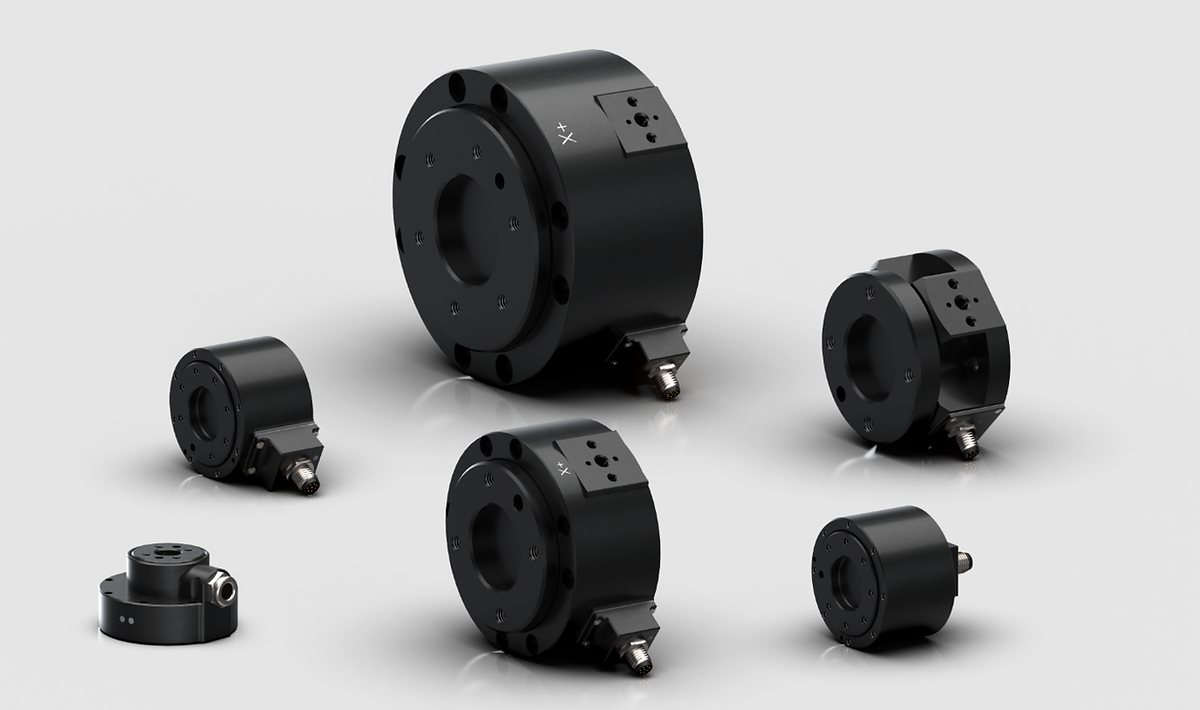
How Force Transducers are Transforming Robotics with Bota Systems
Imagine robots performing delicate surgeries, assembling intricate components, or safely interacting with humans. This is becoming a reality thanks to advanced force-torque transducers from Bota Systems.
Force sensors act like translators for robots. They empower robots to:
Feel how much force they’re using: No more crushing delicate objects or accidentally hurting people!
Know exactly where they’re touching: This is crucial for precise tasks like assembling tiny parts or performing surgery.
Respond to their environment: Robots can adjust their movements based on what they feel, making them safer and more versatile.
Bota Systems: Pioneering the Future of Force Sensors:
Bota Systems is a leader in developing these amazing sensors. Their sensors are super precise as they can even measure the gentlest touch.
They can sense force in different directions, like up, down, and sideways. Moreover, they are customizable and tough enough to handle even the most demanding jobs. Their product line includes:
MiniONE Pro – Ultra-compact and highly sensitive, ideal for precision tasks in small spaces.
MegaONE – Industrial-grade, built for high-performance automation and research.
LaxONE – Lightweight and versatile, designed for collaborative robotic applications.
Explore Bota Systems’ website to learn more about their specific products and how they can empower your next robotic project. With the power of touch, we are shaping the future of robotics!