Space was once known as the “final frontier”, but there’s still a frontier on Earth that’s yet to be fully explored – the oceans. Underwater robots play a crucial role in ocean exploration, especially in areas that are either too dangerous or too expensive for human divers. They are the best automation robots when it comes to ocean exploration.
The underwater robotics market was valued at 4.49 billion in 2022 and is expected to experience a compound annual growth rate (CAGR) of 14.5% between 2023 and 2030. This article offers a detailed overview of underground robots’ advantages, the different types available and what to look at during your research.
What Are Underwater Robots?
There are three different categories of underwater robots – autonomous underwater vehicles (AUVs), remotely operated vehicles (ROVs) and hybrid vehicles that combine AUVs and ROVs.
AUVs use software but operate differently, whereas ROVs need human control from a distance. Each is equipped with different functionalities that allow them to perform different tasks beneath the water surface. They should have the right robotic accessories to perform different tasks effectively.
Components Of Ocean Robots
Power systems and propulsion: Propulsion systems help with the thrust of underwater vehicles. Some of the common types include jet pumps, thrusters and propellers. The power systems include fuel cells, batteries and other systems that assist the robot in performing tasks.
Sensors and communication components: Force torque sensors for instance allow underwater robots to gather information about the surroundings including pressure and temperature. The communication devices allow deep sea robots to transmit data and receive sensor readings.
Control and navigation system: This includes onboard computers, microcontrollers, and software algorithms that help make decisions and control the robot’s actions. Navigating systems assist the robots in planning the route and determining its location.
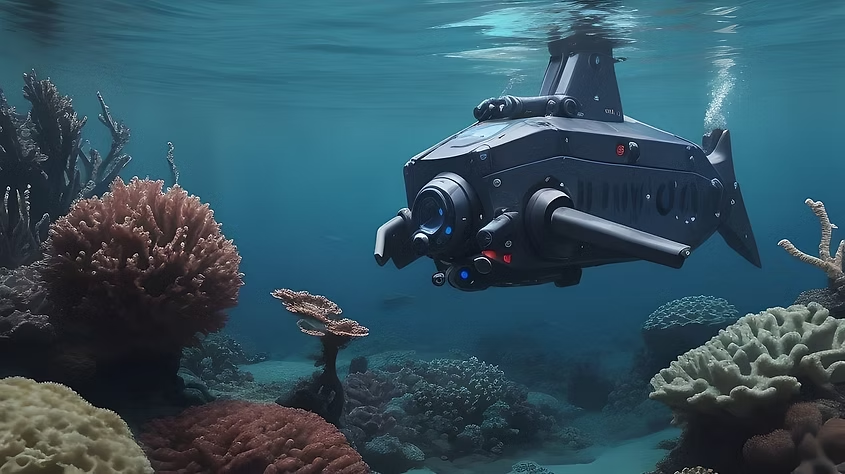
What Are The Uses Of Ocean Robots?
According to the World Economic Forum report, the ocean absorbs almost a third of all carbon emissions. It also soaks up 90% of all the additional hast from global warming. Here are a couple of applications for marine robots:
Research: This involves chemical, biological and geological sample collection for investigation.
Assist with search and rescue operations.
Help with environmental monitoring and observation by tracking oceanographic parameters such as water salinity and temperature.
Deep sea robots also help with resource management and sustainable fishing practices crucial in preserving marine life.
Military defense: Underwater robots can protect naval soldiers from hazardous toxins thanks to their mine detection services.
Types Of Ocean Robots
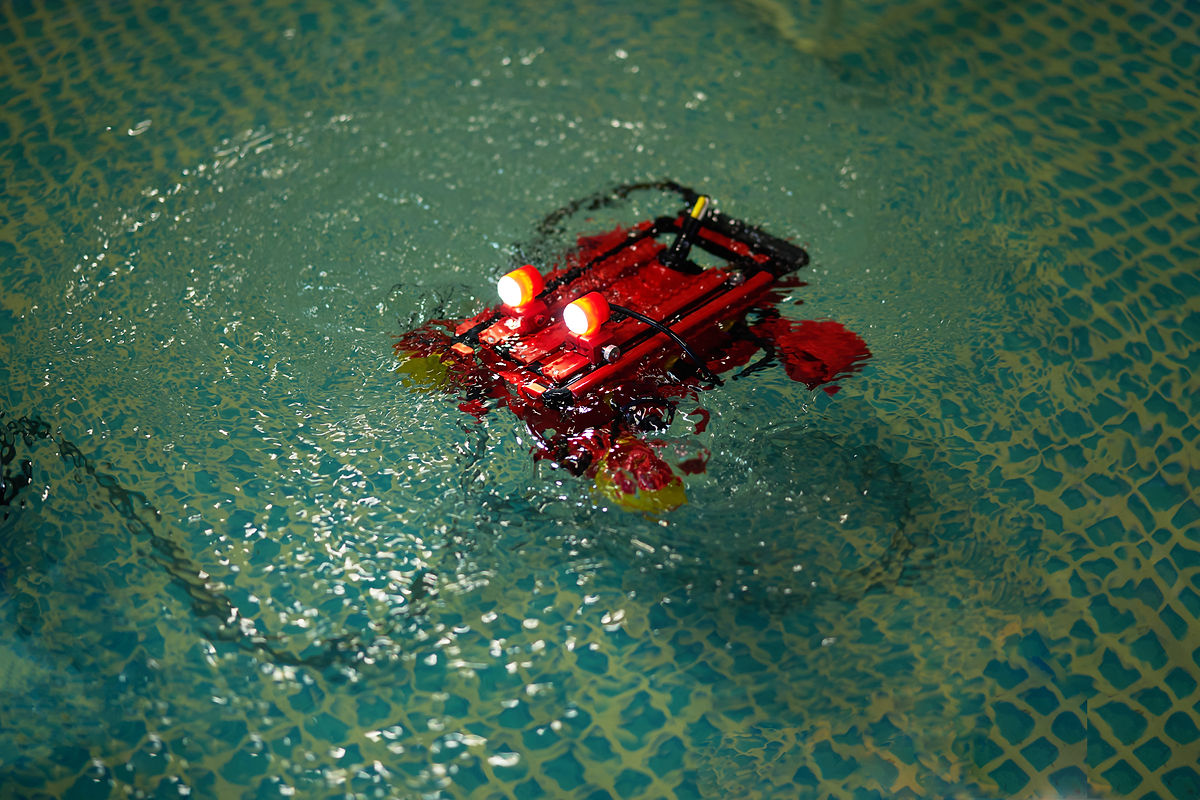
Remotely Operated Vehicles (ROVs)
ROVs range from as small as a basketball to as big as an SUV. They could be used in marine biology, getting submerged infrastructure, and recreational and discovery. There are four different classes of ROVs:
Mini or Micro ROV: These are the smallest class used to inspect shallow areas such as pipes or submerged infrastructure.
Observation Class ROV: These are useful in exploring rivers, coastal waters, and lakes and testing water safety before a diver gets in during water missions.
Light work class ROV: These handle moderate to deep depths within 1000 to 9,800 meters.
Work Class ROV: It is used for ocean floor exploration and inspection of depth waters that divers reach.
Use Cases
They are useful in underwater inspections such as pipelines and shipwrecks.
ROVs help repair and maintain offshore structures.
Useful in marine biology research.
Features
They are equipped with cameras, lights, and manipulators.
ROVs provide real-time data transmission to operators.
Autonomous Underwater Vehicles (AUVs)
AUVs are unmanned underwater robots that operate independently and have no physical connection to their operators. Unlike ROVs that transmit videos through tethers, AUVs store all the data and images on an onboard computer until after AUV is recovered. In 2024, the AUV market was valued at $2 billion and projected to reach $2.3 billion in 2029.
Use Of AUVs
Assist with oceanographic data collection such as collecting temperature, salinity and depth.
These devices are the best for seafloor mapping.
AUVs are ideal for environmental monitoring.
Features
They have sensors, sonar, and sometimes cameras.
AUVs have longer operational ranges compared to ROVs.
Hybrid Underwater Vehicles (HUVs)
There are advanced robotic systems that combine features of both AUVs and ROVs. Therefore, a hybrid underwater vehicle can operate remotely after getting pre-programmed. This makes it a versatile tool in ocean exploration, inspection and research.
Uses
Deep-sea exploration.
Complex maintenance tasks require human intervention.
Features
Versatility in operation modes.
Crawlers
Subsea crawler vehicles are specialized robotic vehicles operating on the seafloor using tracks or wheels to transverse the extreme terrain found in the seabed.
They are equipped with some custom sensors such as environmental monitoring technology, navigation equipment and other mission-specific tools.
Uses
They help with cable and pipeline inspection.
Crawlers are vital for sediment sampling and resource extraction.
Sometimes, scientists use them in mapping while utilizing cameras that capture high-resolution images from the seabed.
Feature
It is durable and often designed for rugged terrain.
Gliders
These winged, low-power autonomous vehicles have a forward thrust, thus changing their buoyancy repeatedly while moving through the water surface. They have a couple of sensors and carry out missions for about six months.
Uses
Long-term oceanographic monitoring.
Climate change research.
Feature
It is energy-efficient with extended mission durations.
Bio-Inspired Robots
These are crucial for deep ocean exploration. Bio-inspired robots help with inspection and rescue missions.
Uses
Marine life monitoring with minimal disturbance.
These are exploration robots that operate in tight or sensitive environments.
Feature
Quiet and energy-efficient propulsion systems.
Swarm Robots
Swarm robotics is a new form of research from swarm intelligence and robotics. These robots work together to handle several applications, including environmental remediation, surveillance, search and rescue and oil spills. In 2022, the swarm robotics market was valued at $635 million and will grow over 25% from 2023 to 2032.
Uses
Large-scale mapping.
Environmental monitoring in expansive areas.
Feature
Distributed intelligence and networked communication.
Underwater Robots Examples
Belle
It is a soft robotic fish designed to collect environmental DNA samples. Belle’s incognito mode allows the machine to explore some of the most delicate ecosystems and look at marine life closely without disruptions.
OceanOneK
It is a deep-sea diving humanoid developed by Stanford University. The robot allows people to feel like they are swimming in the deep ocean and interact and manipulate some submerged objects on the ocean floor.
It was meant to study coral reefs that were out of reach but has also been used to explore sunken submarines, planes and shipwrecks.
The Wave Glider
This robot has an average speed of 2.8 km/h in a sea with one to three feet of sea waves. This uncrewed autonomous vehicle is helpful for data collection and monitoring.
Due to its self sufficiency, the Wave Glider could operate for 12 months without any extra power sources, no crew and without more fuel.
Aquanaut
It is a hybrid underwater robot that can easily perform subsea work sites, such as turning valves and doing tasks human divers should do.
The robot at times transitions into a humanoid ROV that extends two robotic arms that allow specific object manipulation.
WasteShark
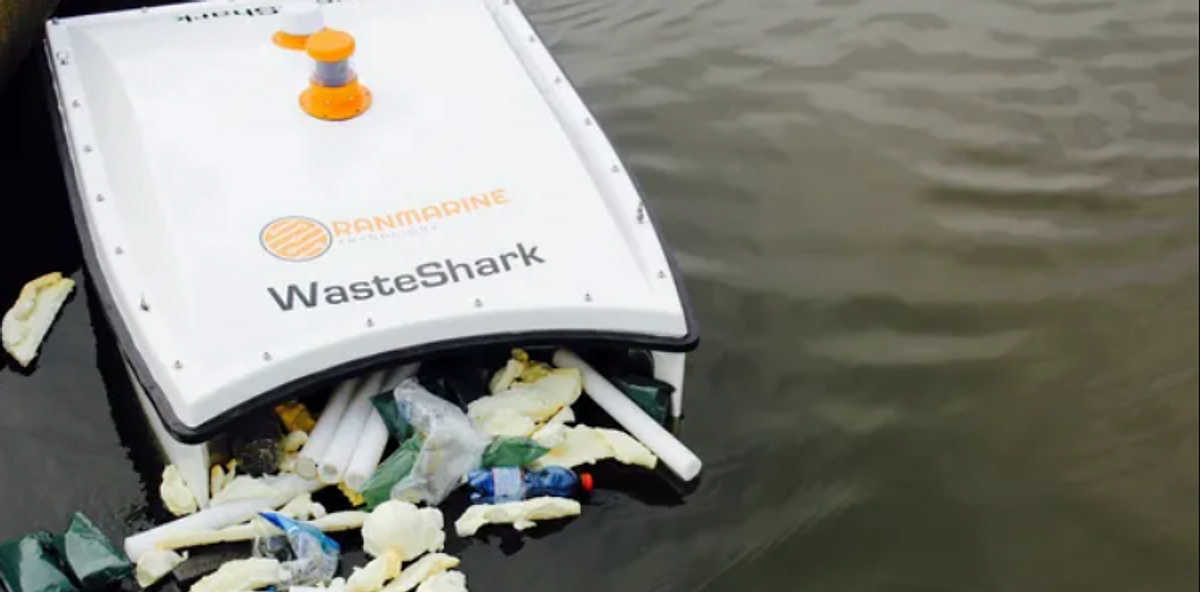
It is an autonomous robot shark that deals with much ocean pollution while protecting marine wildlife. These ocean robots do not challenge marine life since they do not produce any noise.
Notably, the deep sea robot can go as deep as one foot below the surface. It can also function for eight hours before being charged again.
COTSbot
It is an autonomous underwater drone developed by the Queensland University of Technology (QUT) to kill all the starfish destroying the Great Barrier Reef.
It is armed with a stereoscopic camera that provides an in-depth perception of ocean currents and a GPS for navigating.
Thomas (Marine Robot)
It was created in 2013 by ASV Global to collect some crucial marine data. That has assisted in learning more about the sea.
It is equipped with several sensors and cameras. It is made to measure the ocean’s sounds, temperature and salinity, thus keeping marine life safe.
Underwater Robots Are Useful In Streamlining Your Research
Underwater robots rely on advanced technology to perform tasks in challenging environments, and Bota Systems’ force torque sensors play a crucial role in enhancing their capabilities.
These sensors enable precise data collection and manipulation by providing accurate measurements of force and torque, ensuring underwater robots can operate efficiently in diverse applications, from deep-sea exploration to marine life monitoring.
Whether you’re equipping an ROV, AUV, or hybrid system, Bota Systems offers state-of-the-art force torque sensors tailored to meet your underwater robotics needs. Contact us today to discover how our sensors can transform your ocean exploration projects and keep you ahead in this dynamic field.