
In engineering and industrial applications, measuring torque is essential for monitoring and controlling mechanical performance. A rotary torque sensor is a critical device that enables accurate measurement of torque in rotating systems.
These sensors play a vital role in evaluating the efficiency of machinery, optimizing energy use, and preventing mechanical failures. This article explores the working principles, types, and applications of rotary torque sensors.
What is a Rotary Torque Sensor?
A rotary torque sensor (also known as a rotational torque sensor or rotating torque meter) is a device used to measure the torque applied to a rotating shaft.
These sensors are critical in applications requiring accurate measurement of torque in real-time, such as engine testing, electric motor efficiency analysis, and industrial automation.
How Does a Rotary Torque Sensor Work?
A rotary torque sensor measures torque by detecting strain or deformation in a rotating shaft. This is achieved through strain gauges, magnetoelastic properties, or optical techniques.
The measured torque signal is then transmitted using slip rings, telemetry, or wireless systems to a data acquisition unit for real-time monitoring and analysis.
High-speed digital processing ensures accurate readings, making rotary torque sensors indispensable in performance testing and quality control applications.

Sensing Technologies in Rotary Torque Sensors
Rotary torque sensors operate based on various sensing technologies that form the basis of rotary torque measurement:
Strain Gauge Technology:
Most rotary torque sensors use strain gauges bonded to a shaft. As torque is applied, the shaft deforms slightly, causing a change in the electrical resistance of the strain gauge.
This resistance change is converted into an electrical signal, proportional to the applied torque. A torque transducer differs from load cells or force transducers because it experiences torsion rather than direct tension or compression.
Instead of measuring linear forces from opposing directions, it detects rotational force, or torque, applied through a lever effect. To accurately sense this twisting motion, torque sensors use specialized strain gauges that are optimized for detecting torsional stress.
Magnetoelastic Sensing:
Uses the principle of magnetoelasticity, where torque-induced stress changes the material’s magnetic properties.
This variation is detected using sensors that convert it into an electrical output. A key advantage is its non-contact nature, making it ideal for high-speed rotating applications.
Optical and Digital Sensing:
Some advanced sensors use optical encoders or digital measurement systems to detect torque. These systems provide high accuracy and real-time data transmission for industrial automation.
Types of Rotary Torque Sensors
Rotary torque sensors come in different types, depending on their application and measurement method:
1. Contact-Based Rotary Torque Sensors
Contact-based rotary torque sensors rely on physical connections to transmit torque data from the rotating shaft to the stationary data acquisition system.
The most common method is slip rings, which maintain electrical contact while allowing rotation. These sensors often use strain gauge technology, where strain gauges bonded to the rotating shaft measure the deformation due to applied torque.
The signal is then transmitted via the slip rings to a stationary signal conditioner.
2. Non-Contact Rotary Torque Sensors
Non-contact rotary torque sensors eliminate physical connections between the rotating and stationary components, improving reliability and reducing maintenance.
These sensors use wireless telemetry, inductive coupling, or magnetoelastic sensing to transmit data without direct electrical contact.
Applications of Rotary Torque Sensors
Rotary torque sensors are widely used across industries, including:
Automotive Industry: Used for testing engines, transmissions, and drive systems.
Aerospace & Defense: Torque monitoring in aircraft engines and control systems.
Manufacturing & Industrial Automation: Ensuring efficiency in rotating machinery, such as pumps and compressors.
Renewable Energy: Monitoring torque in wind turbines and hydroelectric generators.
Medical Devices: Measuring torque in prosthetics and robotic surgical instruments.
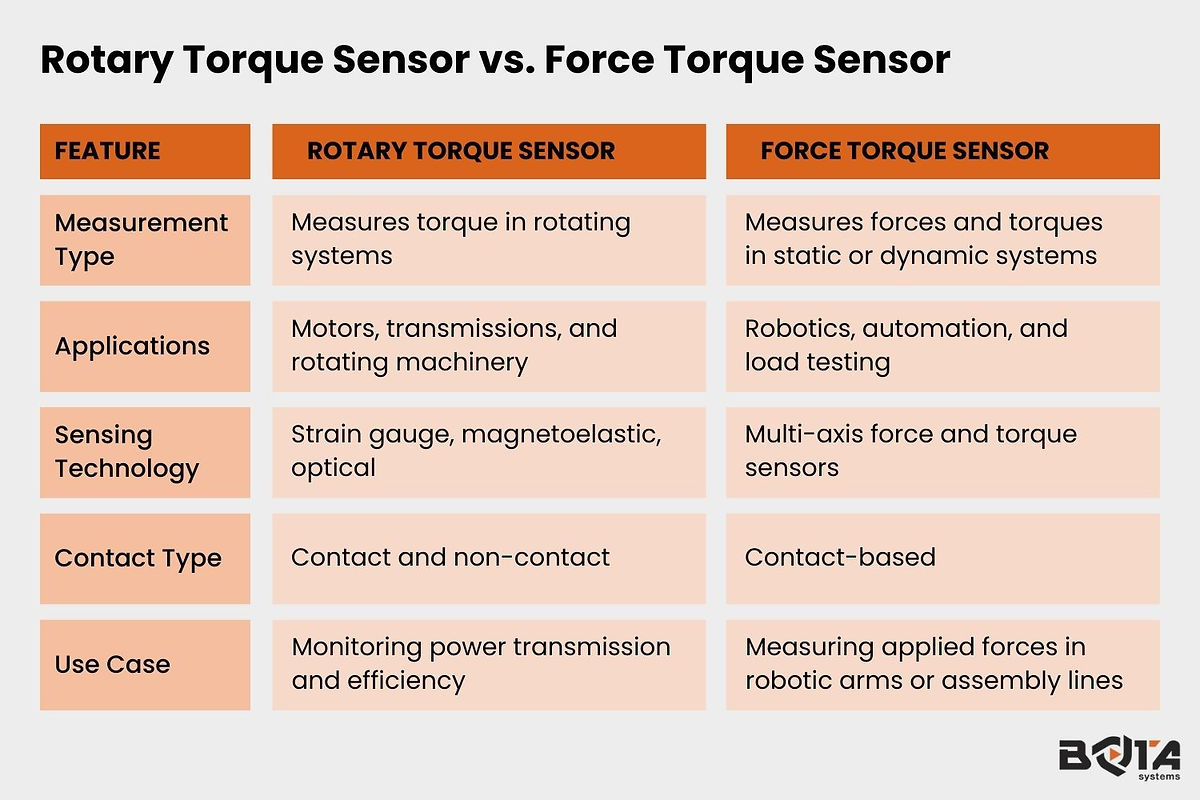
Rotary Torque Sensor vs. Force Torque Sensor
Rotary torque sensors and force torque sensors are designed for different measurement applications, despite both dealing with mechanical loads.
1. Measurement Type
Rotary Torque Sensors: Measure torque (rotational force) in a rotating shaft. These sensors determine the twisting force applied along the shaft’s axis, typically in Nm (Newton-meters).
Force Torque Sensors: Measure both linear forces (Fx, Fy, Fz) and torques (Tx, Ty, Tz) in multiple directions. These sensors are commonly multi-axis and are used in applications requiring detailed force analysis.
2. Applications
Rotary Torque Sensors: Used in motors, gearboxes, and rotating machinery to monitor power transmission, efficiency, and load variations.
Force Torque Sensors: Used in robotics, material testing, and haptic feedback systems, where both forces and torques need to be precisely measured.
3. Sensing Technology
Rotary Torque Sensors: Typically use strain gauges, magnetoelastic sensing, or optical methods to detect torque. Signal transmission can be contact-based (slip rings) or non-contact (wireless telemetry, magnetoelastic coupling).
Force Torque Sensors: Use strain gauge or piezoelectric sensing but are designed for multi-axis force and torque measurement rather than continuous rotation.
4. Rotational Capability
Rotary Torque Sensors: Designed specifically for continuous rotation while measuring torque.
Force Torque Sensors: Usually mounted on robotic end-effectors, load cells, or static structures and are not meant to rotate continuously.
5. Data Transmission & Mounting
Rotary Torque Sensors: Require rotating electrical connections (slip rings) or wireless telemetry for data transfer.
Force Torque Sensors: Mounted on a fixed or semi-fixed structure and transmit data via standard wired or wireless connections.
Both sensor types play a crucial role in industrial automation, robotics, and mechanical testing, but their fundamental differences in measurement capabilities and applications dictate their usage.
Explore Torque-Sensing with Bota Systems
Bota Systems offers a range of 6-axis force torque sensors for precise multi-axis force and torque measurement.
The LaxONE is an industrial-grade sensor supporting up to 50 kg payloads, featuring an integrated 6-DoF IMU, ISO 9409-1-50-4-M6 mounting, embedded electronics, compact design, and high sensitivity for tasks like polishing and assembly.
The SensONE is optimized for collaborative robots with a lightweight, robust build, embedded signal processing, open-source software compatibility (ROS, LabVIEW, MATLAB®), and an IP67 rating for durability in harsh environments.
Bota Systems’ sensors are engineered for precision, durability, and seamless integration, making them ideal for industries ranging from robotics and automation to research and manufacturing.
With advanced features like embedded electronics, high sensitivity, and open-source compatibility, these sensors enhance efficiency and control in demanding applications.
Explore Bota Systems’ lineup to find the perfect sensor for your specific needs and elevate your force and torque measurement capabilities.
Choosing the Right Torque Sensor
When selecting a torque sensor for a rotating shaft, consider the following factors:
Measurement Range: Ensure the sensor can handle the expected torque values.
Accuracy Requirements: Choose high-precision sensors for critical applications.
Rotational Speed: Some sensors are designed for high-speed applications.
Data Transmission Method: Decide between slip rings, wireless telemetry, or digital output.
Application: Determine whether the measurement involves purely rotational torque or multi-axis forces and torques.
Environmental Factors: Assess factors such as exposure to dust, moisture, and temperature variations to select a sensor with appropriate IP ratings and material construction.

Emerging Trends in Rotary Torque Sensing
Modern rotary torque sensors are evolving with advancements in wireless telemetry, eliminating the need for slip rings and enhancing data transmission reliability.
AI-driven analytics are being integrated for predictive maintenance, enabling real-time fault detection in rotating machinery. Miniaturization and lightweight designs are improving sensor integration in robotics and compact industrial systems.
Additionally, non-contact sensing technologies, such as magnetoelastic and optical methods, are gaining traction for high-speed and high-precision applications, reducing wear and extending sensor lifespan.
These innovations are driving greater accuracy, efficiency, and durability in torque measurement across various industries.
Conclusion
Rotary torque sensors are essential in various industrial and research applications, enabling precise torque measurement in rotating systems.
By understanding their working principles andapplications, engineers and manufacturers can select the best sensor for their needs.
For those looking to invest in high-quality torque measurement solutions, Botasys provides a range of sensors tailored to different industrial needs.