
Ever felt that satisfying click when you perfectly tighten a bolt? That sweet spot where you know it’s secure but not stripped?
Now imagine applying that same precision not with your hand, but with a machine.
That’s the magic of torque sensors. They keep machines safe and running smoothly by measuring the twisting force, or torque, that is being used.
Let’s delve into the fascinating realm of torque sensors, exploring how they work, their diverse applications, and the future they promise.
Principles of Operation for a Torque Sensor
Before we answer the question, what is a torque sensor and how it works, it’s important to understand the concept of torque.
Torque, the force that drives rotation, lies at the heart of countless mechanical systems. Whether measuring the torque of an engine, the twist of a bolt, or the spin of a wind turbine, accurate torque measurement is indispensable.
In engineering parlance, torque is the product of force and distance, measured in units like Newton-meters (Nm) or pound-feet (lb-ft).
A torque sensor operates based on the fundamental principle of measuring the twist or rotational force applied to an object. When torque is applied to a shaft or a surface, it induces a deformation or strain in the material. This deformation can be measured and correlated to the applied torque.
These torque sensors typically work by utilizing two main methods: strain gauges and magnetoelastic sensors.
Strain gauges are tiny devices that deform when torque is applied, and this deformation translates into an electrical signal.
Magnetoelastic sensors, on the other hand, rely on changes in a magnetic field caused by torque to generate an electrical output.
The electrical signal from either method is then processed to provide a precise measurement of the torque.
There are also the optical sensors that use light-based measurement techniques to detect torque-induced deformation. These sensors often employ principles like interferometry or polarimetry to measure changes in optical properties caused by torque.
Each sensing method has its advantages and limitations, and the choice depends on factors like the required accuracy, environmental conditions, and application-specific requirements. By understanding these principles and technologies, engineers can select the most suitable torque sensor for their needs, ensuring precise and reliable torque measurement in various applications.

Common Components and Technology Used in Torque Sensors:
Strain Gauges
These are the most common components in torque sensors. Strain gauges are thin wires or foil patterns applied to a surface. When torque is applied, the strain gauge deforms, causing a change in its electrical resistance. This change in resistance is measured and correlated to the applied torque.
Rotating Shaft
In many torque sensors, a rotating shaft is used to transmit torque from the source to the sensor. This shaft is usually made of a durable material like steel and is designed to withstand high torque loads.
Signal Conditioning Circuitry
To accurately measure the small changes in resistance or other properties caused by torque, torque sensors often include signal conditioning circuitry. This circuitry amplifies and processes the sensor signals before they are sent to data acquisition systems for further analysis.
Housing and Mounting Mechanism
Torque sensors are typically housed in sturdy enclosures to protect them from environmental factors and mechanical stress. They also include mounting mechanisms to securely attach them to the system being measured.
Types of Torque Sensors:
Static Torque Sensors
These sensors measure torque in stationary or slow-moving systems, finding applications in calibration, quality control, and assembly line monitoring.
Dynamic Torque Sensors
Dynamic torque sensors excel in high-speed applications, providing real-time data for precise control in areas such as automotive testing and machinery diagnostics.
Shaft Torque Sensors
Mounted directly on rotating shafts, these sensors offer direct measurement of torque, essential in applications like engine testing and industrial machinery.
Rotary Torque Sensors
Versatile and accurate, rotary torque sensors cater to a wide range of applications, from robotics and automation to renewable energy systems.
Inline Torque Transducers
Designed for integration into existing machinery, inline torque transducers facilitate seamless torque measurement in various industrial processes.
Non-Contact Torque Sensors
Employing innovative methods like optical or magnetic sensing, non-contact torque sensors eliminate the need for physical contact, ideal for delicate or high-speed applications.
Motor Torque Sensors
Embedded within motors, these sensors monitor torque for precise control in applications ranging from robotics to medical devices.
Torque Sensors vs Torque Transducers
In many cases, the terms are used interchangeably but there’s a very subtle difference between a torque sensor and a torque transducer.
Torque Sensor is the broader term that refers to any device that can measure torque. It encompasses various technologies and designs, as long as their primary function is to measure rotational force.
On the other hand, the term Torque Transducer is more specific and refers to a type of torque sensor that converts the measured torque into an electrical signal. This electrical signal can then be easily transmitted, processed, and displayed.
So, all torque transducers are torque sensors, but not all torque sensors are torque transducers. Some torque sensors might output a mechanical signal or require additional processing before converting it to an electrical signal.

Applications of Torque Sensors
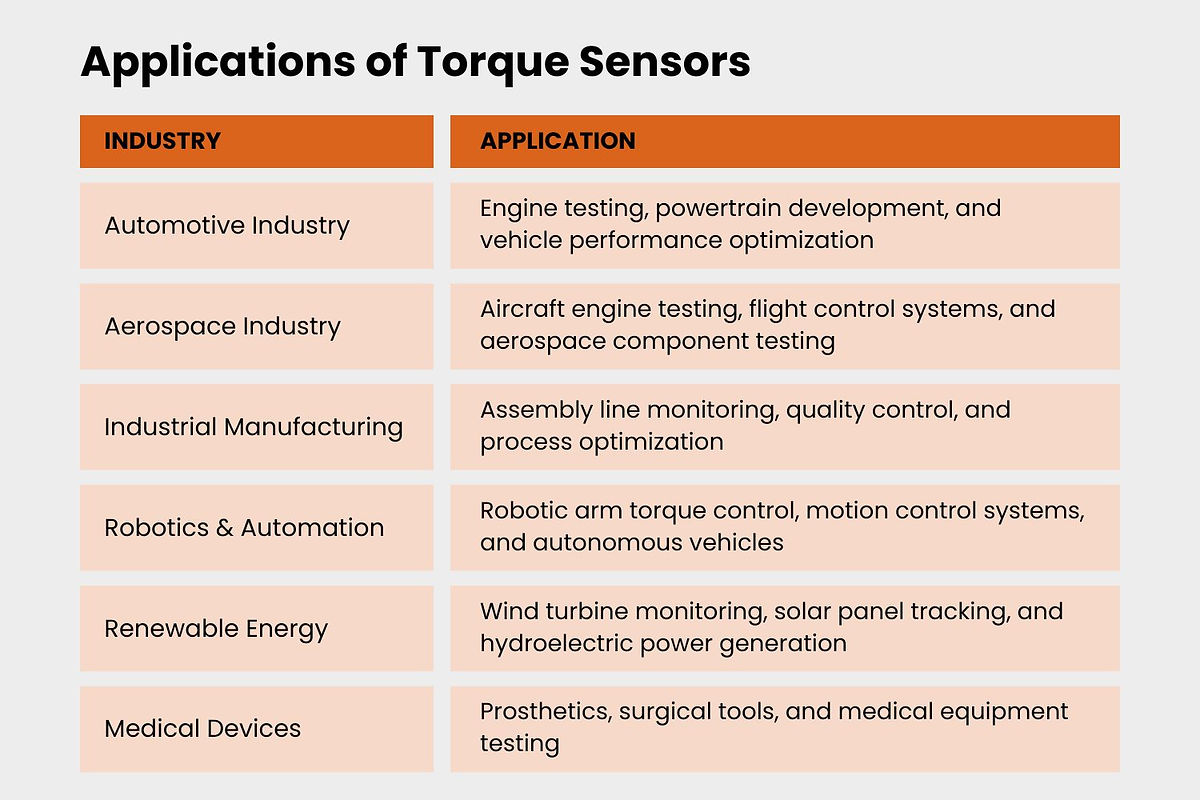
The applications of torque sensors are vast and extend across numerous industries:
Manufacturing: Torque sensors ensure quality control by monitoring the tightness of bolts on assembly lines and controlling the force applied by robots during various tasks.
Aerospace: These sensors play a vital role in monitoring engine performance and optimizing fuel efficiency in aircraft. They also contribute to research and development of new propulsion and control systems.
Automotive: The torque output of engines and transmissions is a critical parameter for performance and fuel efficiency. Torque sensors provide the necessary data for optimizing engine design and ensuring smooth transmission operation.
The use of torque sensors extends beyond these core industries and the figure below summarizes important applications.
Advanced Torque-Sensing With Bota Sytems
Bota Systems is a leading developer and manufacturer of multi-axis force-torque sensors. Their sensors are designed to provide exceptional precision and reliability, catering to a wide range of applications.
For instance, MiniONE sensor, known for its compact size, is ideal for applications where space is limited but high sensitivity is required. The Medusa sensor, on the other hand, offers exceptional sensitivity for tasks demanding the utmost precision in measuring minute torque changes.
By leveraging Bota Systems’ advanced torque sensing solutions, you can gain valuable insights into the performance of your machines, optimize processes, and ensure safety and efficiency in your operations.
Conclusion
Torque sensors play a vital role in ensuring the smooth operation, efficiency, and safety of various machines across numerous industries. By understanding their working principles, different types, and applications, you can appreciate the importance of these silent guardians in the world of machinery.
As technology advances, torque sensors are expected to become even more sophisticated, offering even greater capabilities for monitoring and controlling the complex systems that power our world.