The debate around robotics vs automation is more relevant than ever. As industries digitize and intelligent machines become mainstream, many professionals still ask: Are robotics and automation the same thing? Or is there a meaningful difference between automation vs robotics?
While the terms are often used interchangeably, they represent distinct but closely related concepts. Understanding the difference between automation and robotics is critical for manufacturers, system integrators, and technology leaders making investment decisions. Let’s clarify the confusion once and for all.
What Is Automation?
Automation is the application of control systems, software, and electromechanical components to execute predefined processes with minimal human intervention. In the context of robotics vs automation, automation refers specifically to process-level control and optimization, independent of whether a physical robot is involved.
At its core, automation refers to the use of technology to perform tasks with minimal human intervention.
From a technical standpoint, automation systems are built around closed-loop control architectures that integrate:
- Sensors (temperature, pressure, vision, force, proximity)
- Controllers (PLCs, microcontrollers, industrial PCs)
- Actuators (motors, solenoids, hydraulic systems)
- Human–Machine Interfaces (HMIs)
- Communication networks (EtherCAT, Modbus, PROFINET, CAN)
Automation is fundamentally about ensuring that a sequence of operations executes reliably, repeatedly, and within defined performance tolerances.
Key Characteristics of Automation
- Rule-based operation
- Predefined logic and sequences
- Focus on efficiency and consistency
- Can be mechanical, electrical, or software-driven
Automation answers the question: “How can we eliminate manual steps in a process?”
What Is Robotics?
Robotics, on the other hand, is a field of engineering focused on designing, building, and operating robots.
A robot is typically a programmable machine capable of carrying out complex physical tasks autonomously or semi-autonomously. In the discussion of robotics vs automation, robotics specifically refers to the mechanical embodiment of intelligence and control — systems that physically interact with the environment.
A robotic system typically integrates:
- Mechanical structure (links, joints, end-effectors)
- Actuation systems (electric motors, hydraulic or pneumatic drives)
- Sensors (force-torque, vision, encoders, proximity sensors)
- Embedded control systems
- Motion planning and kinematics algorithms
Unlike automation, which focuses on process control, robotics focuses on physical task execution. Robots are capable of manipulating objects, navigating spaces, assembling components, or interacting safely with humans.
Robotics answers the question: “How can we build intelligent machines that physically interact with the world?”
Core Technical Components of Robotics vs Automation Systems
To properly understand robotics vs automation, it is essential to view them as complementary layers within a unified cyber-physical architecture.
While robotics provides mechanical embodiment and physical interaction, automation delivers process control, coordination, and system-level intelligence. Modern automation and robotics platforms integrate both domains seamlessly.
Example:
- A sensor detects an object on a conveyor.
- Automation logic determines the correct handling procedure.
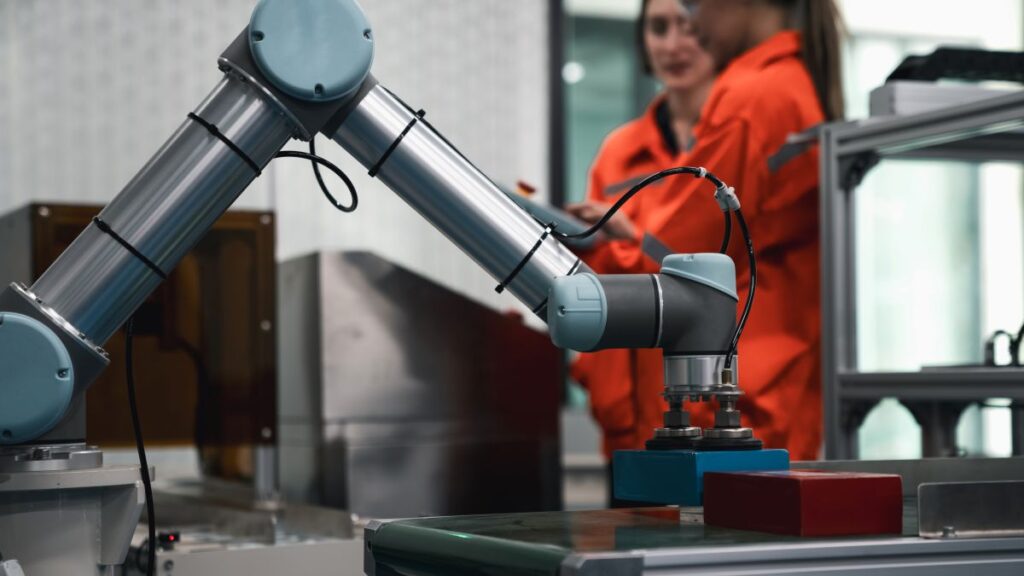
- A robotic arm picks and places the object.
- A vision system verifies placement.
- Feedback updates the system state.
Here, automation governs the process, and robotics performs the physical action.
Below are the foundational technical components that define integrated robotic and automation systems.
1. Control Logic and Task Orchestration
At the automation layer, control logic governs sequencing, synchronization, and safety across the system. In robotics applications, control logic coordinates motion planning with process requirements.
Common implementations include:
- Ladder logic
- Function block diagrams
- Structured text
- Finite state machines
In robotic and automation environments, control logic ensures that robot motion, sensor feedback, and external devices operate coherently within predefined operational constraints.
2. Feedback Control Systems
Both robotics and automation rely heavily on closed-loop control systems to maintain precision and stability.
Typical control strategies include:
- PID control
- Model-based control
- Adaptive control
- Supervisory control
In automation, feedback maintains process stability (e.g., temperature, pressure, flow rate). In robotics, feedback regulates joint position, velocity, torque, and force interaction.
This shared dependence on control theory highlights that automation vs robotics is not a competition but a layered integration of process control and physical execution.
3. Sensing, Monitoring, and Data Acquisition
Advanced robotics and intelligent automation systems require continuous environmental awareness and data feedback.
Key technologies include:
- SCADA systems
- Real-time telemetry
- Edge computing platforms
- Sensor fusion frameworks
In automation, monitoring ensures process consistency. In robotics, sensing enables perception, manipulation accuracy, and safe human interaction.
4. Industrial Integration and Connectivity
Modern automation and robotic systems operate within interconnected industrial ecosystems.
Integration components include:
- MES and ERP connectivity
- Cyber-physical system architectures
- Industrial IoT (IIoT) networks
- Fieldbus and real-time communication protocols
Automation manages production workflows and data exchange, while robotics performs dynamic physical tasks within that coordinated framework.

System-Level Perspective
A key distinction in robotics vs automation is that automation can operate independently of physical robotic structures. For example:
- A turbine speed regulation loop in a power plant is automation.
- A chemical batching control system is automation.
- A warehouse routing algorithm is automation — even without a robotic manipulator.
However, when mechanical systems such as robotic arms or autonomous mobile robots are introduced, automation becomes the orchestration layer that governs their operation.
In practice, automation with robots represents the most advanced implementation — combining control logic, sensing, communication, and mechanical intelligence into a unified, scalable system.
Comparison Table
| Aspect | Automation | Robotics |
|---|---|---|
| Focus | Process optimization | Physical machine design |
| Requires robot? | No | Yes |
| Physical interaction | Not necessarily | Yes |
| Intelligence level | Often rule-based | Can include AI |
| Application scope | Manufacturing, software, infrastructure | Manufacturing, logistics, healthcare, defense |
So when discussing robotics and automation, it’s helpful to see robotics as a subset of broader automation strategies.
What Is Robotics and Intelligent Automation?
As technology advances, we move beyond basic automation toward robotics and intelligent automation.
Traditional automation relies on rigid rules. Intelligent automation incorporates:
- Machine learning
- Computer vision
- Adaptive control
- Real-time force feedback
- Predictive analytics
Robotics combined with intelligent automation allows systems to:
- Adapt to uncertainty
- Learn from new data
- Handle variable objects
- Interact safely with humans
For example, collaborative robots equipped with force-torque sensing can adjust their grip dynamically when assembling delicate components.
This shift transforms automation from rigid and repetitive to flexible and adaptive.
Industrial Use Cases: Automation vs Robotics in Practice
1. Automotive Manufacturing
Automation Only Example: Programmable conveyor systems and automated paint spraying lines.
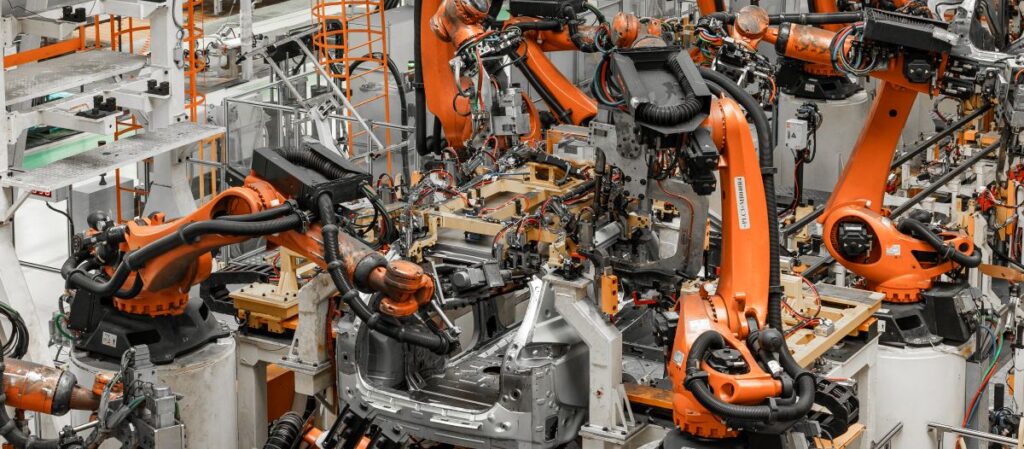
Robotics Example: Multi-axis robotic arms performing welding and assembly.
In reality, automotive plants use both robotics and automation simultaneously.
2. Warehousing and Logistics
Automation:
- Barcode scanning systems
- Conveyor routing systems
- Inventory management software
Robotics:
- Autonomous mobile robots (AMRs)
- Robotic picking arms
Together, they form a cohesive automated fulfillment system.
3. Healthcare
Automation:
- Automated medication dispensing
- Digital workflow management
Robotics:
- Surgical robots
- Rehabilitation robots
Here, robotics enhances precision, while automation streamlines operations.
Common Misconceptions About Robotics vs Automation
Misconception 1: Automation Always Involves Robots
False. Many automated systems operate purely through sensors and control logic.
Misconception 2: Robots Automatically Mean AI
Not necessarily. Many industrial robots follow predefined trajectories without artificial intelligence.
Misconception 3: Robotics Replaces Automation
In reality, robotics expands automation capabilities.
Automation and Robotic Systems: Degrees of Flexibility
One major difference between automation and robotics lies in flexibility.
Traditional Automation
- Designed for fixed tasks
- High efficiency in stable environments
- Expensive to modify
Example: Bottling plants optimized for one bottle size.
Robotics
- Programmable for multiple tasks
- Easier reconfiguration
- Adaptable to product variations
Example: Robotic arms that can switch between assembling different components.
When combined, robotics and automation create systems that balance efficiency with adaptability.
When Should You Choose Automation vs Robotics?
Choose Automation When:
- The task is repetitive and stable
- Environment is predictable
- High-speed throughput is required
- Minimal physical manipulation is needed
Choose Robotics When:
- The task involves complex physical interaction
- Objects vary in shape or position
- Precision manipulation is required
- Flexibility is important
Choose Automation with Robots When:
- You need both process control and physical handling
- The system must scale
- Intelligent adaptation is beneficial
The Role of Sensors in Robotics and Automation
In the discussion of robotics vs automation, sensing technology is the critical enabler of performance, precision, and safety.
In automation systems, sensors:
- Trigger process actions
- Maintain closed-loop stability
- Monitor key variables such as position, pressure, and temperature
- Provide real-time feedback for reliable operation
In robotic systems, sensing goes further. Robots must physically interact with dynamic environments, which requires:
- Force and torque feedback for compliant manipulation
- Vision systems for object detection and positioning
- High-speed data for adaptive control
This is where Bota Systems plays a key role in modern automation and robotics applications. Bota Systems develops high-precision multi-axis force-torque sensors designed for real-time robotic interaction. Their sensors enable:
- Accurate force-aware assembly
- Safe human–robot collaboration
- Consistent surface finishing and material handling
- Stable, high-bandwidth control loops
In advanced automation with robots, precision sensing is not optional — it defines system intelligence. Without reliable, high-resolution feedback, neither automation nor robotics can achieve true performance, adaptability, or safety.
Final Thoughts: Understanding Robotics vs Automation
To summarize, automation focuses on eliminating manual processes through structured control systems, logic, and feedback mechanisms, while robotics centers on designing and deploying machines capable of physically performing tasks in real-world environments.
Understanding the distinction between robotics vs automation enables organizations to make more informed investment decisions, design scalable and flexible production systems, enhance operational safety and efficiency, and prepare strategically for AI-driven transformation.
In modern industry, competitive advantage does not come from automation alone or robotics alone, but from their deliberate and intelligent integration. As intelligent systems continue to mature, mastering the synergy between automation and robotic technologies will define the next generation of industrial innovation.