
Torque is the turning force that causes an object to rotate around an axis or pivot point. It is widely used in physics, automotive engineering, robotics, and machinery design.
To calculate torque, multiply force by the distance from the pivot point and the sine of the angle between them. Understanding torque helps engineers design safer and more efficient mechanical systems.
This comprehensive guide will walk you through the process of calculating torque, explaining the necessary formulas and concepts along the way.
What Is Torque?
Torque, also called the moment of force, measures how strongly a force causes rotational motion. The greater the force applied and the farther it is applied from the pivot point, the greater the torque produced.
The SI unit of torque is the newton-meter (N·m). For example, applying 10 newtons of force at a distance of 0.5 meters creates 5 N·m of torque.
Imagine a seesaw. The force you apply as your weight and the distance you sit from the pivot point determine how easily the seesaw tilts.
This principle applies to all situations involving torque. The greater the force applied and the farther it’s exerted from the pivot point, the greater the torque produced.
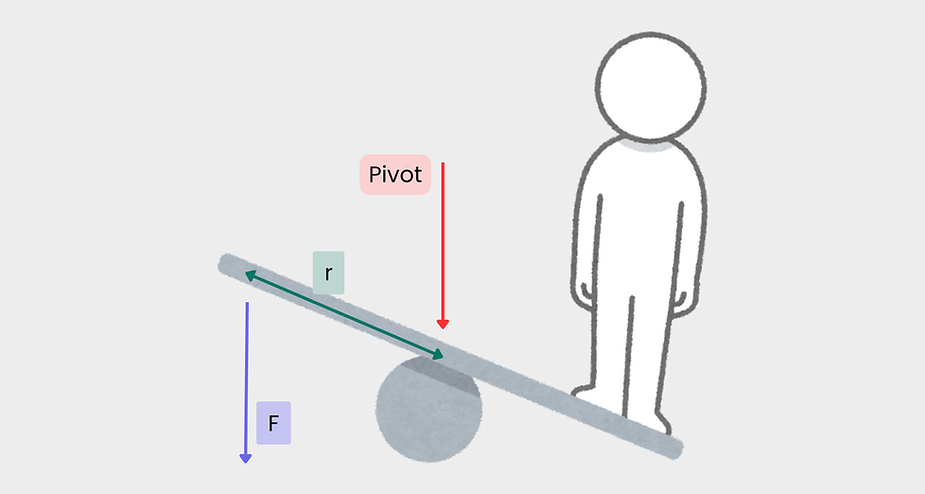
How to Calculate Torque
Let’s first look at the torque formula and then move on to some solved examples that illustrate how to calculate torque using the torque equation.
The Torque Formula
The formula for calculating torque is:
τ (torque) = F (force) × r (lever arm) × sin(θ)
Where:
- τ (tau) represents torque (measured in newton-meters, N⋅m)
- F (force) represents the magnitude of the force applied (measured in newtons, N)
- r (lever arm) represents the distance from the fulcrum/pivot point to the point where the force is applied (measured in meters, m)
- θ (theta) represents the angle between the force vector and the lever arm (measured in degrees or radians)
The lever arm is the effective perpendicular distance between the pivot point and the line of action of the force. Torque increases as this distance increases.
Torque is highest when the force is applied at 90° to the lever arm. If the force acts directly along the lever arm (0°), torque is zero.

Examples of Torque Calculations
Here are a few examples that explain how to calculate torque.
Example 1: Perpendicular Force
Suppose you apply a force of 10 N at the end of a 0.5-meter wrench. The angle between the force and the lever arm is 90°.
Solution:
τ = r × F × sin(θ)
τ = 0.5 × 10 × sin(90°)
τ = 0.5 × 10 × 1
τ = 5 N·m
Answer: The torque applied is 5 N·m.
Example 2: Tightening a Lug Nut
Imagine you’re tightening a lug nut on a car tire with a 0.5-meter wrench. You apply a force of 50 N at an angle of 30° to the handle.
Solution:
τ = r × F × sin(θ)
τ = 0.5 × 50 × sin(30°)
τ = 0.5 × 50 × 0.5
τ = 12.5 N·m
Answer: The torque applied to the lug nut is 12.5 N·m.
Example 3: Seesaw Balance
Two children of different weights are playing on a seesaw. One child weighing 40 kg sits 2 meters from the fulcrum, while the other child weighs 30 kg. How far from the fulcrum should the lighter child sit to balance the seesaw?
Solution:
For balance, the torques on both sides must be equal.
τ₁ = τ₂
40 × 2 = 30 × d
80 = 30d
d = 80 / 30
d ≈ 2.67 m
Answer: The lighter child should sit approximately 2.67 meters from the fulcrum.
Example 4: Torque in a Car Engine
A car engine applies a force of 1500 N to a crankshaft. The distance from the center of the crankshaft to the point where the force is applied is 0.1 meters. Assume the force is applied tangentially (90°).
Solution:
τ = r × F × sin(θ)
τ = 0.1 × 1500 × sin(90°)
τ = 0.1 × 1500 × 1
τ = 150 N·m
Answer: The engine produces 150 N·m of torque.
Example 5:Rotational Torque in a Robotic Arm
A robotic arm applies a force of 200 N at the end of its 0.5-meter arm segment. The force is applied at an angle of 60°.
Solution:
τ = r × F × sin(θ)
τ = 0.5 × 200 × sin(60°)
τ = 0.5 × 200 × 0.866
τ = 100 × 0.866
τ = 86.6 N·m
Answer: The robotic arm produces 86.6 N·m of torque.
Quick Torque Reference Table
| Force | Distance | Angle | Torque |
|---|---|---|---|
| 10 N | 0.5 m | 90° | 5 N·m |
| 50 N | 0.5 m | 30° | 12.5 N·m |
| 200 N | 0.5 m | 60° | 86.6 N·m |
Additional Considerations
- Torque as a Vector Quantity: While the formula illustrates how to find the magnitude of torque, torque is also a vector quantity with direction. The right-hand rule can be used to determine the direction of torque.
- Average Torque: In situations where the force or angle varies, you might need to calculate the average torque over time.
Practical Applications
Torque calculation is essential in various fields. Here are a few examples that show the importance of knowing how to calculate torque in Engineering Design:
- Automotive engineering: engine output, wheel nuts, braking systems
- Structural engineering: load balancing and beam forces
- Mechanical design: motors, gears, rotating systems
- Robotics: Ensuring precise and reliable movements
- Manufacturing: tightening fasteners to exact specifications
How Torque Is Measured
Measuring torque is essential for ensuring the accuracy and reliability of various mechanical systems.
This involves using tools like torque wrenches, which apply a specific torque to fasteners, and force-torque sensors, which measure the torque in both static and rotating systems such as engines and robotic arms.
Accurate torque measurement helps in preventing mechanical failures, optimizing performance, and ensuring safety in applications ranging from automotive engines to robotic arms. Properly calibrated torque measurement tools are crucial for maintaining the integrity and efficiency of engineered systems.
Estimating Torque by Hand
A rough torque estimate can be made by applying a known force at a known distance. For accurate engineering work, calibrated tools should always be used.
Conclusion
Torque is a core concept in mechanics that explains how forces create rotational motion. By understanding the torque formula, units, and real-world applications, you can solve engineering problems more accurately and design more efficient systems.
Bota Systems develops advanced force torque sensors for robotics, automation, and precision machinery. Our sensors help engineers measure forces and moments accurately in real time for safer and more reliable performance.
FAQs About Torque
What is the formula for torque?
τ = r × F × sin(θ)
What are torque units?
Torque is measured in newton-meters (N·m).
Is torque highest at 90 degrees?
Yes. Torque is maximum when force is perpendicular to the lever arm.
How do you calculate torque on a wrench?
Multiply the applied force by the wrench length and the sine of the angle.