
Sensors have become an essential part of modern technology, helping to gather data from our environment for various applications, from industrial machinery to consumer electronics.
At the heart of this technology are two main types of sensors: analog and digital.
Understanding the fundamental differences between analog and digital sensors is crucial for engineers, developers, and enthusiasts who need to choose the right type for their projects.
In this article, we will explore the topic “analog-vs-digital sensors” and explain the key differences between analog and digital sensors, including their operating principles, applications, and advantages.
By the end, you will have a clear understanding of which sensor type might be best suited for your needs.
Analog-vs-Digital Sensors: What are they?
What is an Analog Sensor?
An analog sensor is a type of sensor that converts a physical quantity (such as temperature, pressure, light, or sound) into a continuous signal.
This signal is typically represented by a varying voltage or current that is directly proportional to the measured quantity. For example, a thermistor, a common analog sensor, changes its resistance in response to temperature changes, which in turn modifies the output voltage.
Analog sensors are widely used in applications where a precise, continuous signal is required, such as audio processing, temperature monitoring, and industrial measurements.
Analog Sensors Examples:
Thermistors for temperature measurement
Potentiometers for position or angle detection
Photocells for measuring light intensity
Microphones for capturing audio signals
What is a Digital Sensor?
A digital sensor, on the other hand, outputs data in a digital format, typically as binary code (0s and 1s). Instead of providing a continuous range of values, digital sensors send discrete signals, which makes them ideal for applications where data needs to be processed digitally.
These sensors are highly valued in applications that require data to be processed, stored, or transmitted with minimal signal degradation.
Digital Sensors Examples:
Digital thermometers for temperature measurements
Accelerometers for measuring acceleration and movement
Digital pressure sensors for measuring atmospheric pressure
Proximity sensors for detecting the presence or absence of objects

Working Principle: Analog-vs-Digital Sensors
How Analog Sensors Work
Analog sensors detect physical phenomena and output a continuous, variable signal that corresponds directly to the measured quantity.
Here’s a breakdown of the process.
Analog sensors use elements that respond to environmental changes (temperature, force, light). The change in the sensing element’s properties (resistance, capacitance, etc.) modifies the output signal.
Since analog signals can be weak or noisy, they often require signal conditioning. This includes amplification (boosting signal strength), filtering (removing noise), and linearization (correcting non-linear sensor outputs) before sending to an analog input.
The conditioned analog signal is then sent to the monitoring or control device. Analog signals are smooth and continuous, allowing them to represent values at any point within their range.
How Digital Sensors Work
Digital sensors also detect physical quantities but convert the analog signal to a digital one before output.
Digital sensors use similar elements (e.g., thermocouples for temperature, MEMS accelerometers for motion), which produce an analog signal initially.
The sensor’s built-in Analog-to-Digital Convertor (ADC) converts the analog signal into a digital format. The ADC samples the analog signal at set intervals (sampling rate) and quantizes it into discrete levels based on the ADC’s bit depth.
Common ADCs are 8-bit, 10-bit, or 12-bit, where a 10-bit ADC can quantize the signal into 1024 levels (2^10). Sampling rate determines how often the sensor takes a measurement. Faster rates are necessary for rapidly changing signals. High quality digital sensors sometimes can have up to 24-bit ADCs.
Digital sensors often include built-in processing to refine data before output. They may have calibration routines to compensate for sensor drift or environmental factors and even simple algorithms for averaging or filtering.
The digital output (typically in binary) is sent to a digital interface, such as I²C, SPI, or UART, to communicate with microcontrollers or computers. More interfaces are included in more advanced sensors like USB, EtherCAT, Ethernet, RS-422 or RS-485.
Key Differences Between Analog and Digital Sensors
Let’s take a look at the primary distinctions between analog and digital sensors, from their working principles to practical applications.
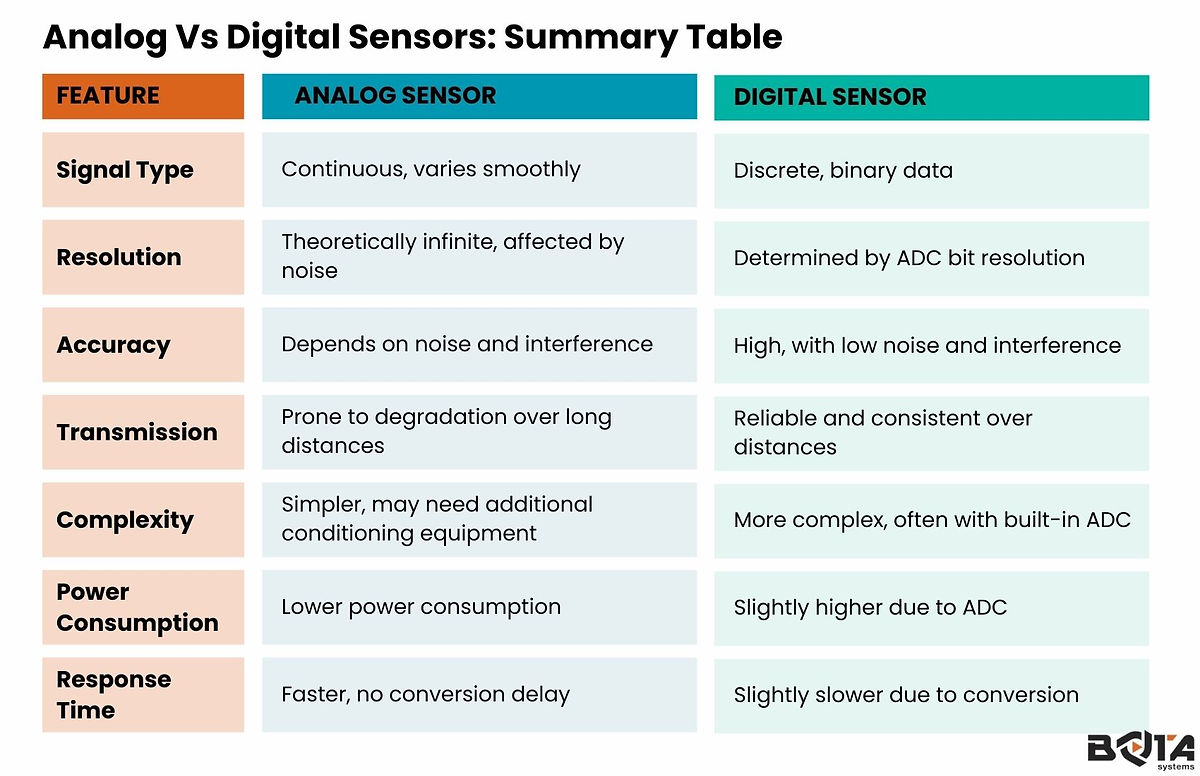
1. Signal Output
Analog Sensors produce a continuous output signal, which varies in a range that represents the measured physical quantity. This range can be any value within a specified minimum and maximum.
Digital Sensors output data in a binary or discrete format, meaning they can only provide a limited set of values. This signal is typically more stable and immune to noise compared to analog signals.
2. Resolution and Accuracy
Analog Sensors offer a theoretically infinite resolution because they measure continuously. However, accuracy can be affected by noise, signal degradation over distance, and the quality of the components.
Digital Sensors provide high precision, often limited by the resolution of the ADC used. For example, an 8-bit ADC offers 256 levels of quantization, while a 12-bit ADC offers 4096 levels. Digital sensors are less prone to signal degradation and interference, making them more accurate for many applications.
3. Data Transmission
Analog Signals can suffer from signal degradation and interference, especially over long transmission distances. This makes analog sensors more challenging to integrate into modern digital systems without conversion.
Digital Signals are immune to most forms of analog noise and interference, ensuring that data remains intact over long distances. Digital sensors are easy to integrate with digital systems like microcontrollers and computers, making data acquisition and analysis simpler.
4. Complexity and Cost
Analog Sensors are often simpler in design and may have fewer components, which can make them more affordable. However, they may require additional hardware like amplifiers, filters, or signal conditioners to improve accuracy.
Digital Sensors typically include an ADC and may have additional features like calibration or signal processing. This added complexity can make them more expensive, but they can reduce the need for additional conditioning equipment.
5. Power Consumption
Analog Sensors generally consume less power, as they lack the complex circuitry required for data conversion. This makes them ideal for applications where low power is essential, such as battery-operated devices.
Digital Sensors may consume more power due to their ADCs and additional circuitry, but power-efficient designs are common, especially in sensors meant for wearable devices and IoT applications.
6. Response Time
Analog Sensors tend to have faster response times since they do not involve data conversion steps. For high-speed applications, analog sensors are often preferable.
Digital Sensors may introduce a slight delay due to the ADC process. However, advances in ADC technology have minimized this difference, making digital sensors suitable for many real-time applications.
When to Use Analog Sensors?
Since we are covering the topic of analog-vs-digital sensors, it’s important to know when and where analog and digital sensors are used. Analog sensors are suitable in scenarios where:
High-resolution and continuous data are required, such as audio processing and temperature monitoring.
Low power consumption is crucial, particularly in simple, battery-powered applications.
Quick response times are needed, and the data doesn’t require conversion for analysis.
Examples of Applications:
Temperature control systems in HVAC
Audio processing equipment like amplifiers and sound meters
Industrial machinery that requires continuous monitoring of variables such as pressure and force
When to Use Digital Sensors?
Moving on in our exploration of analog-vs-digital sensors, let’s see when is the right time to select and use digital sensors. Digital sensors excel in applications where:
Data accuracy and precision are paramount, and interference from noise needs to be minimized.
Integration with digital systems is required, such as microcontrollers, computers, or IoT platforms.
Data transmission over long distances is necessary, where signal integrity must be preserved.
Examples of Applications:
Smartphones and wearable devices for tracking movement, location, or environmental conditions
Automated systems and robotics that rely on precise and stable sensor input. Force torque sensors are often used.
Internet of Things (IoT) applications where data is processed and transmitted remotely
Digital Sensors in Robotics
In robotics, digital sensors provide precise, interference-resistant data, essential for real-time robotic control and adaptability. Unlike analog sensors, which output a continuous signal, digital sensors deliver discrete, quantized data, which minimizes noise and ensures data integrity even in challenging environments.
This reliability is critical for tasks like object manipulation, where exact pressure and movement control are required.
Digital sensors also enable seamless communication with robotic systems through standard protocols, allowing robots to perform complex actions such as detecting objects, mapping environments, and interacting safely with humans.
Conclusion
Both analog and digital sensors have their unique advantages and limitations, making them suitable for different types of applications.
Analog sensors offer simplicity and low power consumption, ideal for applications where continuous monitoring is required. Digital sensors, with their precision and compatibility with digital systems, excel in modern, data-driven environments.
Choosing between analog and digital sensors depends on the specific requirements of your application.
For projects requiring integration with microcontrollers, long-distance data transmission, or noise immunity, digital sensors are usually the better choice.
Conversely, if simplicity, speed, and low power are priorities, analog sensors might be the ideal solution.
Understanding these distinctions can help engineers and developers select the most appropriate sensors for their needs, optimizing performance and efficiency in various applications.