SHARE:
Table of Contents
Robotics in aerospace is no longer a futuristic curiosity—they are fundamental to the evolution of aviation and space industries.
The aerospace robotics sector is expanding rapidly, fueled by the rising demand for automation in aviation, space exploration, and defense. The global aerospace robotics industry was estimated at USD 2.75 billion in 2023 and is forecasted to climb from USD 3.14 billion in 2024 to around USD 8.32 billion by 2031.
This article explores what robots in aerospace are, their applications, enabling technologies, benefits, challenges, and future trends—highlighting real-world examples to ground the discussion.
What Is Robotics in Aerospace?
Robotics in aerospace are specialized machines designed to operate within the aerospace industry, handling tasks that require precision and reliability. They play crucial roles in the manufacturing, assembly, inspection, and maintenance of aircraft and spacecraft.
These aerospace robots improve efficiency and quality by managing delicate components and repetitive processes that are difficult or risky for humans.
The integration of robotics in aerospace allows manufacturers to achieve higher standards of accuracy and speed while reducing costs.
Robotics also extends beyond manufacturing, supporting space exploration with adaptable technologies for satellite operations and other space missions. This makes robots in aerospace an essential part of advancing both aviation and space industries.
Why Use Robotics in Aerospace?
Robots for aerospace applications deliver substantial advantages across manufacturing and maintenance processes. They are capable of handling delicate components with exceptional precision, minimizing the risk of damage and ensuring superior quality in both aircraft and spacecraft assembly.
By automating repetitive and time-intensive tasks, these robots significantly enhance operational efficiency. This, in turn, frees human engineers to concentrate on higher-value work—complex problem-solving, system design, and innovation.
Robots also excel in environments that pose safety risks to humans. From inspecting hazardous areas to managing toxic materials, they take on dangerous tasks that would otherwise expose workers to potential harm, thereby reducing workplace accidents.
In addition to safety and efficiency, aerospace robots contribute to meaningful cost savings. Their ability to boost productivity while minimizing errors leads to lower production costs and shorter project timelines.
Applications of Robots in Aerospace
Robots in aerospace perform diverse tasks demanding precision and repeatability. Their use improves efficiency, safety, and quality in critical manufacturing processes and maintenance operations.
Drilling
Robotic drilling systems ensure exact hole placement and depth on composite panels and metal structures. This precision reduces material waste and prevents damage to expensive aerospace components.
Automation also reduces operator fatigue from repetitive tasks, increasing overall process consistency. Robots can work with various drill sizes and materials, adapting quickly to different aircraft models while maintaining strict tolerance requirements.
Assembly
Robots assist in assembling complex parts such as airframe sections and engine components. Their ability to handle small fasteners and intricate geometries improves assembly speed without sacrificing precision.
Collaborative robots (cobots) are increasingly used to work alongside technicians, handling repetitive or heavy tasks like positioning parts or inserting bolts. This integration enhances human productivity and ensures consistent quality across batches.
Painting
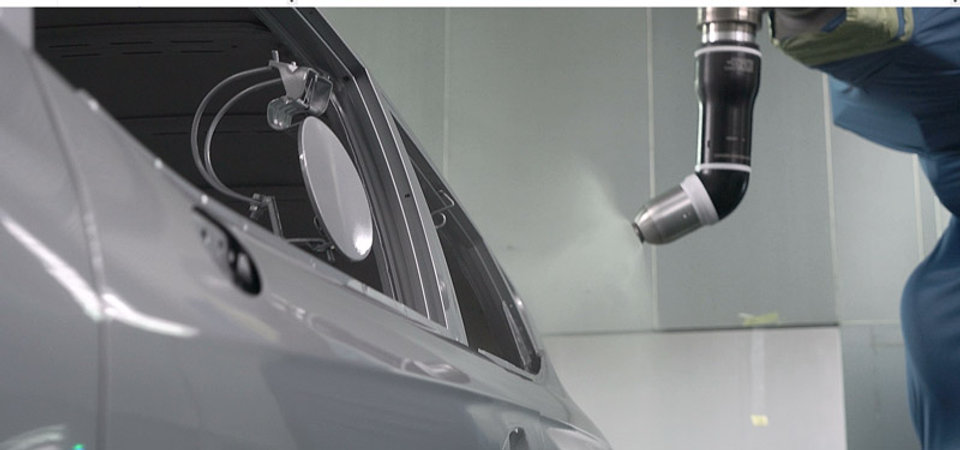
Robotic painting adds uniform coatings to aircraft surfaces, improving finish quality and reducing environmental impact. Robots follow programmed paths to ensure even application and minimize paint waste.
They can apply multiple coats quickly with adjustable spray patterns suited to complex shapes. This control reduces overspray and supports compliance with strict aerospace standards for surface treatment.
Welding
Robots perform precision welding on critical aerospace components, including structural joints and engine parts. Their consistent heat application minimizes warping and ensures strong, defect-free welds.
Automation speeds up operations and can execute specialized weld types like friction stir welding, common in aircraft assembly. Robotic welding improves repeatability compared to manual methods and enhances overall structural integrity.
Inspection
Robots equipped with sensors and cameras conduct thorough inspections of aircraft parts and assemblies. Automated non-destructive testing catches defects early, such as cracks or corrosion, supporting quality control.
These systems can scan large surfaces and hard-to-reach areas quickly, providing detailed data for analysis. Continuous inspection by robots helps maintain safety and compliance with aerospace regulations.
Conclusion
Robotics in aerospace is profoundly transforming both industry and exploration—elevating standards of safety, precision, speed, and innovation from manufacturing floors to remote planetary landscapes.
Yet, fully leveraging this technological shift demands more than just advanced hardware—it calls for strategic investments in artificial intelligence, adaptable robotics, forward-looking regulation, and ethical governance.
Innovations like those from Bota Systems, which pioneer compact, high-performance multi-axis force-torque sensors, highlight how robotics is becoming more sensitive, intuitive, and capable of delicate operations. By embedding “a sense of touch” into robotic arms, Bota’s technology empowers robots to perform polishing, assembly, and sanding tasks with remarkable precision and responsiveness—even in complex environments.
As we ride this wave of robotic advancement, success will hinge on multidisciplinary collaboration—among policymakers, engineers, researchers, and industry leaders.
The journey ahead isn’t just about building smarter robots; it’s about crafting a future where these machines enhance human capability and safety, operate responsibly, and push aerospace exploration forward in ways once thought impossible.
References
Extrapolate. (2023). Aerospace Robotics Market: Global Share and Growth Trajectory. Link.
Hémono, P., Chabane, A. N., & Sahnoun, M. H. (2025). Multi objective optimization of human–robot collaboration: A case study in aerospace assembly line. Computers & Operations Research, 174, 106874. Link.
author