SHARE:
Table of Contents
Artificial intelligence (AI) and robotics are rapidly redefining healthcare, moving the industry from reactive treatment toward intelligent, adaptive, and scalable care.
What was once limited to experimental systems and niche surgical tools has evolved into a broad ecosystem of intelligent machines supporting clinicians, patients, researchers, and hospital operations.
Today, AI and robotics in healthcare are not just about automation. They represent a shift toward systems that can perceive, learn, and interact physically with humans in safe and meaningful ways.
This convergence is unlocking new possibilities in precision medicine, remote care, rehabilitation, and hospital efficiency – while addressing some of healthcare’s most urgent challenges.
Why AI and Robotics Are Transforming Healthcare
Healthcare systems worldwide face mounting pressure. Aging populations, chronic disease prevalence, staff shortages, and rising operational costs are stretching hospitals and care providers beyond sustainable limits. At the same time, expectations for quality, safety, and personalization of care continue to rise.
AI addresses these challenges by extracting actionable insights from vast amounts of medical data – improving diagnostics, predicting outcomes, and supporting clinical decision-making.
Robotics extends these capabilities into the physical world, enabling machines to act on those insights through movement, manipulation, and interaction.
When combined, AI and robotics enable healthcare systems to scale expertise, reduce human error, and deliver consistent performance across diverse clinical environments.
Rather than replacing healthcare professionals, these technologies augment human skill, allowing clinicians to focus on complex judgment, empathy, and patient relationships.
The Evolution of Robots in Healthcare
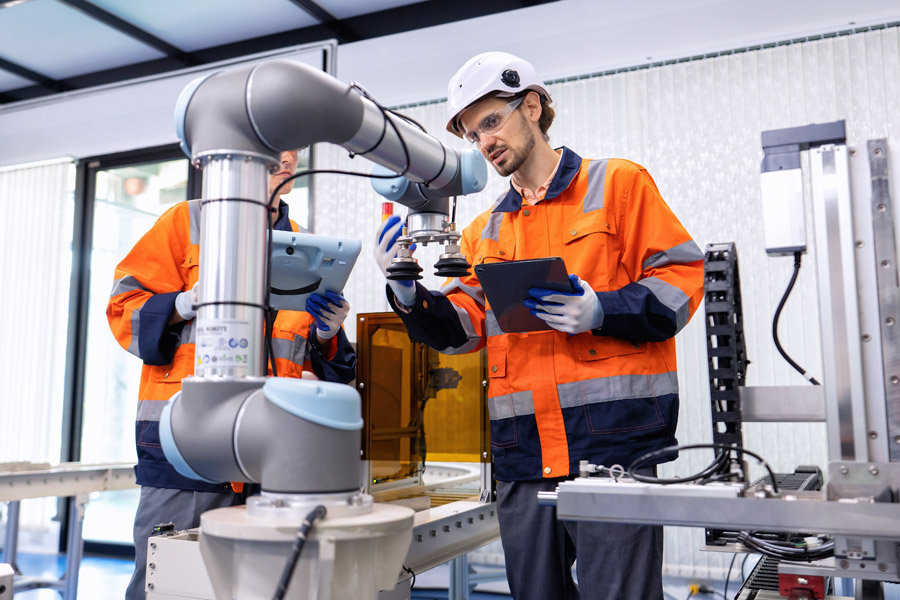
The journey of robotics in healthcare began with highly controlled, task-specific machines. Early systems focused on precision and repeatability, such as robotic arms assisting surgeons or automating laboratory workflows.
As sensor technology, computing power, and AI algorithms advanced, healthcare robotics became more capable and autonomous. Surgical systems gained enhanced dexterity and imaging integration.
Mobile robots entered hospitals to perform logistics tasks such as:
- Transporting supplies
- Samples
- Medications
More recently, the focus has shifted toward robots in hospitals that operate safely in shared spaces with humans. These environments are dynamic and unpredictable, requiring robots to adapt in real time.
This evolution has highlighted the importance of compliance, force regulation, and physical awareness – capabilities that traditional rigid robots lacked.
The Role of AI in Robotic Healthcare Systems
AI acts as the intelligence layer within robotic healthcare platforms. It enables robots to interpret sensor data, recognize patterns, and make decisions in complex environments.
Key AI functions include:
- Machine learning for predicting patient responses and optimizing robotic behavior
- Computer vision for recognizing anatomy, instruments, and obstacles
- Natural language processing for clinician interaction and workflow integration
- Reinforcement learning for acquiring skills through trial, error, and demonstration
However, AI depends heavily on data quality. In physical systems, inaccurate or incomplete sensor data can undermine even the most advanced algorithms.
This is why AI-driven robotics must be grounded in reliable, high-fidelity physical sensing.
Why Force and Touch Are Essential in Healthcare Robotics
Healthcare is inherently physical. Whether manipulating surgical instruments, assisting patient movement, or handling medical devices, robots must interact safely with delicate biological structures.
Vision alone cannot provide sufficient information about contact forces, resistance, or material compliance. Force and torque sensing allow robots to detect subtle changes in interaction, such as increased resistance or unintended contact.
This capability is essential for:
- Preventing injury during patient handling
- Maintaining consistent force during surgical procedures
- Enabling adaptive assistance in rehabilitation
- Supporting learning from demonstration in research settings
As robots become more autonomous, the ability to “feel” becomes a prerequisite for trust, safety, and regulatory acceptance.
Enabling Safe Human-Robot Interaction with Advanced Sensing
Safe human-robot interaction is one of the defining requirements of healthcare robotics. Robots must operate reliably in close proximity to patients and clinicians, often under unpredictable conditions.
Advanced force-torque sensing enables robots to:
- Instantly detect collisions or excessive force
- Maintain compliance during physical interaction
- Adapt behavior based on real-time feedback
- Meet stringent medical safety standards
This has driven demand for compact, highly integrated sensors that provide accurate force data without adding complexity to system design.
Technologies developed by Bota Systems play an important role in this shift. By enabling precise, real-time force and torque measurement, such sensing solutions support safer interaction, improved repeatability, and faster development of intelligent healthcare robots – particularly in research, teleoperation, and physical AI applications.
Real-World Use Cases of AI and Robotics in Healthcare
AI-powered robotic systems are already delivering measurable value across healthcare environments.
These real-world applications demonstrate how intelligence, autonomy, and physical interaction combine to improve safety, efficiency, and patient outcomes.
1. Robotic-Assisted Surgery
Robotic-assisted surgery is one of the most mature and impactful applications of AI and robotics in healthcare. These systems enhance surgical precision by filtering hand tremors, scaling motion, and enabling minimally invasive procedures that reduce trauma and recovery time for patients.
AI supports surgical workflows through image analysis, anatomical recognition, and real-time guidance.
However, intelligence alone is not enough. Surgical robots must also regulate force precisely to avoid damaging delicate tissue. This has increased the importance of force-aware control, enabling surgeons to maintain consistent pressure and receive tactile feedback during complex procedures.
As surgical robotics evolves toward greater autonomy, accurate force and torque sensing will remain critical for patient safety and clinical trust.
2. Hospital Automation and Logistics Robots
Hospitals are complex, fast-paced environments where staff time is often consumed by repetitive logistical tasks. Autonomous hospital robots are increasingly used to transport medications, lab samples, linens, and medical equipment throughout healthcare facilities.
AI enables these robots to navigate crowded corridors, avoid obstacles, and optimize routes in real time. At the same time, physical awareness is essential to ensure safe operation around patients, visitors, and staff. Force-sensitive interaction allows robots to detect contact, regulate motion, and respond safely to unexpected situations.
By automating logistics, hospitals can reduce operational bottlenecks, lower infection risk, and allow clinical staff to focus more on direct patient care.
3. Rehabilitation and Physical Therapy Robotics
Rehabilitation robotics plays a growing role in patient recovery following injury, surgery, or neurological conditions such as stroke. These systems assist patients with repetitive therapeutic movements, helping restore mobility, strength, and coordination.
AI-driven models analyze patient performance and adapt therapy parameters over time. Force-controlled interaction enables robots to provide just the right level of assistance or resistance, adjusting dynamically based on patient effort and progress.
This combination allows rehabilitation programs to become more personalized, consistent, and scalable – especially valuable in settings facing shortages of trained physical therapists.
4. Teleoperation and Remote Healthcare Robotics
Teleoperated robotic systems extend the reach of clinicians beyond physical boundaries. Surgeons can perform procedures remotely, specialists can consult in underserved regions, and healthcare workers can interact with patients in high-risk or isolated environments.
AI enhances teleoperation by stabilizing motion, compensating for latency, and supporting decision-making. However, without force feedback, operators lose critical situational awareness. Haptic feedback and force sensing restore the sense of touch, enabling clinicians to feel resistance, texture, and contact remotely.
These capabilities are essential for maintaining precision, safety, and confidence in remote medical interventions.
Benefits of AI and Robotics in Healthcare
The widespread adoption of AI and robotics delivers benefits across clinical, operational, and economic dimensions:
- Improved patient safety and outcomes
- Greater procedural precision and consistency
- Reduced clinician fatigue and burnout
- Enhanced efficiency in hospital operations
- Expanded access to specialized care
- Accelerated research and innovation
By augmenting human expertise, robotic systems help healthcare providers deliver higher-quality care at scale.
Challenges and Limitations of Healthcare Robotics
Despite significant progress, healthcare robotics faces important challenges:
- Regulatory approval requires extensive validation and documentation
- Ethical concerns around autonomy, accountability, and patient trust
- Integration complexity with legacy hospital systems
- Sensor reliability in real-world clinical environments
- Cost barriers for large-scale deployment
Overcoming these challenges requires continued collaboration between technology developers, clinicians, researchers, and regulators.
The Future of AI and Robotics in Healthcare
The future of healthcare robotics lies in Physical AI – systems that seamlessly integrate intelligence with real-world interaction. These robots will be more autonomous, adaptive, and capable of learning directly from human guidance.
Key trends shaping the future include:
- Greater use of force-sensitive robotic platforms
- Expansion of semi-autonomous care systems
- Growth of remote and teleoperated healthcare
- Deeper integration of AI models with physical sensing
As these trends converge, force-aware robotics will remain a foundational technology enabling safe, effective, and scalable healthcare solutions.
Conclusion
AI and robotics are fundamentally reshaping healthcare by combining intelligent decision-making with precise physical interaction. As these systems mature, their success will depend not only on smarter algorithms, but on their ability to interact safely, reliably, and intuitively with the human body.
Healthcare environments demand an exceptionally high standard of safety, adaptability, and trust. Robots that can sense force, regulate contact, and respond in real time are better equipped to support clinicians, protect patients, and expand access to high-quality care.
As the industry moves toward Physical AI and increasingly autonomous systems, accurate force awareness will remain a cornerstone of responsible innovation.
Bota Systems plays a key role in enabling this future by giving robots a reliable sense of touch. Through high-precision, compact force-torque sensing and streamlined software integration, Bota Systems helps researchers, medical device developers, and robotics engineers build healthcare robots that can interact safely with humans and complex environments.
References
- Ala’a, A. (2023). Adoption of artificial intelligence and robotics in healthcare: a systematic literature review. International Journal of Contemporary Management and Information Technology (IJCMIT), 3(6), 1-16. Link.
- Elendu, C., Amaechi, D. C., Elendu, T. C., Jingwa, K. A., Okoye, O. K., Okah, M. J., … & Alimi, H. A. (2023). Ethical implications of AI and robotics in healthcare: A review. Medicine, 102(50), e36671. Link.
author