Ever wondered what is a sensor?
These devices are all around us, quietly working in the background. From the thermometers in our homes to the complex systems in self-driving cars, sensors are crucial tools in technology, science, and medicine.
This article will explain what sensors do, how they work, and the many ways in which they impact our everyday lives.
What is a sensor?
Let’s define a sensor in simple terms: sensors are essentially devices that detect and respond to environmental changes. These changes can be temperature, light, pressure, or even the presence of chemicals.
Sensors are fundamental components in a wide array of applications, ranging from industrial automation and environmental monitoring to consumer electronics and medical devices. They provide critical data that enable systems to understand and interact with their surroundings.
Imagine a robot arm tasked with picking up a delicate egg. A force sensor in the gripper can detect the pressure being applied and send signals to the robot’s control system. This allows the robot to adjust its grip strength in real-time, ensuring the egg is grasped firmly but gently enough to avoid cracking.
Sensors come in a variety of types, including electronic, mechanical, optical, chemical, biological, and thermal sensors. Each type of sensor is designed to detect specific physical or chemical properties and convert them into signals that can be measured and interpreted.
In this article, we are going to focus specifically on electronic sensors. In essence, electronic sensors act as translators between the physical and the digital world. They convert physical changes into electrical signals, enabling us to measure, analyze, and interact with our surroundings in numerous ways.
How does a Sensor Work?
Now that we have looked into the sensor definition, let’s see how a sensor works in order to further answer the original question: what is a sensor?
The seemingly simple act of a sensor detecting and responding to its environment involves a fascinating interplay between physics and electrical engineering.
Before diving into the working mechanism of a sensor, its important to first understand the difference between a sensor and a transducer.
Sensors vs Transducers
A sensor is a type of transducer that specifically detects physical phenomena (such as temperature, pressure, or light) and converts them into readable electrical signals.
While sensors are focused on sensing and measurement, transducers encompass a broader range of devices that convert energy from one form to another, including sensors as well as devices like loudspeakers and microphones that convert electrical energy into mechanical energy and vice versa.
Thus, all sensors are transducers, but not all transducers are sensors
Sensor working principle
A sensor operates through a systematic process that involves several key stages.
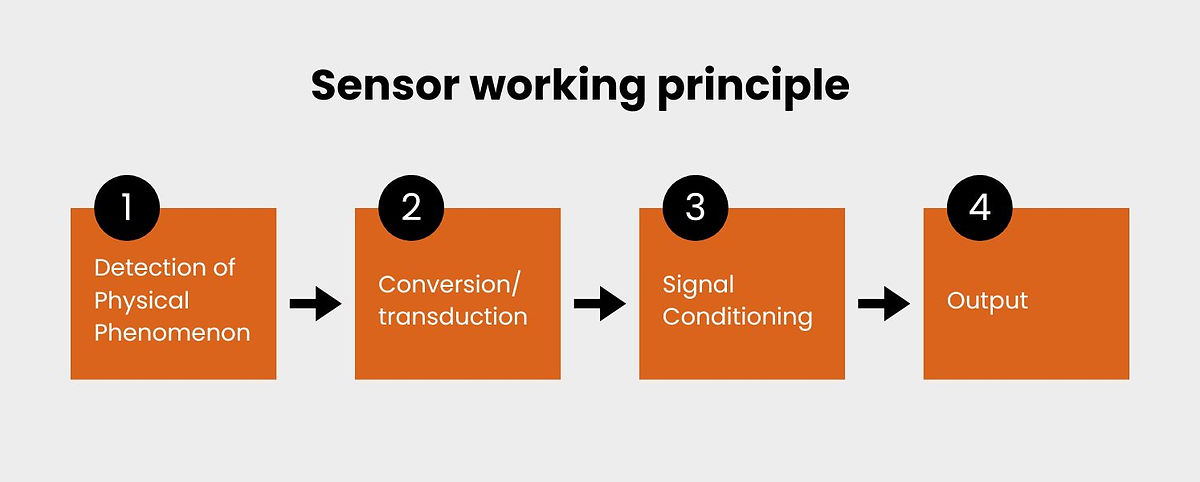
By following this process, sensors convert real-world physical phenomena into electrical signals that can be utilized for monitoring, control, and data analysis in various applications.
The sensor contains a sensing element that directly interacts with the physical property being measured. This could involve materials or components that change in response to temperature, light, pressure, etc.
Next comes the conversion stage where the transduction happens. The sensing element converts the detected physical change into an initial electrical signal. This initial signal is often small and not yet in a usable form.
These stages of operation are best explained with the help of an example. For example, in a thermocouple, the temperature difference between two junctions of different metals generates a small voltage. This phenomenon occurs because the two metals have different electron densities, causing a voltage to develop when they are subjected to a temperature gradient. he magnitude of this voltage is directly related to the temperature difference between the junction and the other ends of the metals.
After the conversion stage, the initial electrical signal is then processed to enhance its usability. It is called signal conditioning. This stage may involve amplification to increase the signal strength, filtering to remove unwanted noise, and other modifications to linearize the response.
After conditioning, the processed signal is outputted as a readable voltage. This output voltage can be easily read by a temperature monitoring device or a data acquisition system. The final voltage signal is proportional to the temperature difference, allowing accurate temperature readings to be displayed or recorded.
Types of Electronic Sensors
A comprehensive understanding of “What is a sensor?” necessitates an exploration and discussion of the most common electronic sensor types.
Here’s a breakdown of some common sensor categories based on what they measure:
Temperature Sensors
These electronic sensors measure temperature variations.
Examples include thermometers (using liquid expansion), thermistors (electrical resistance change with temperature), and thermocouples (voltage generation based on temperature difference between two metals).
Light Sensors
As the name suggests, these sensors detect light intensity or absence.
Photodiodes and phototransistors are common types, converting light into an electrical current. They’re used in applications like automatic lighting control and security systems.
Pressure Sensors
These electronic sensors measure the pressure of gases or liquids.
Many types exist, but some common ones use a diaphragm that flexes under pressure, causing a change in electrical resistance or capacitance. These are crucial in car tires, weather monitoring systems, and various industrial processes.
Position Sensors
These sensors determine the location or orientation of an object.
Encoders, potentiometers, and gyroscopes are some examples. Encoders convert shaft rotation into electrical pulses, potentiometers translate linear movement into resistance change, and gyroscopes detect rotational motion. They play a vital role in robotics, motion control systems, and navigation.
Force Sensors
These sensors measure the amount of force applied to an object.
They often rely on strain gauges, which are essentially wires that change resistance when deformed under force. This principle is used in robotic grippers and weight scales.
Proximity Sensors
Proximity sensors detect the presence or absence of an object without physical contact.
Inductive Sensors use electromagnetic induction to detect metallic objects, often used in industrial automation.
Capacitive Sensors detect changes in capacitance due to the presence of any material, suitable for detecting both metallic and non-metallic objects.
Ultrasonic Sensors use sound waves to measure the distance to an object, useful in parking sensors and robotic navigation.
Infrared Sensors use infrared light to detect objects and measure distance, applied in remote controls and motion detectors.
Motion Sensors
Motion sensors detect and measure movement. Accelerometers measure acceleration forces, essential in smartphones for screen orientation and in automotive airbag systems.
Gyroscopes measure rotational motion and orientation, crucial in navigation systems for drones and spacecraft. PIR (Passive Infrared) Sensors detect motion by measuring changes in infrared radiation, commonly used in security systems and automatic lighting.
Sound Sensors
Sound sensors detect and measure sound waves.
Microphones convert sound waves into electrical signals, used in audio recording and communication devices. Piezoelectric Sensors generate an electrical signal in response to sound vibrations, applied in ultrasonic sensors and musical instruments.
Touch Sensors
Touch sensors detect physical contact or pressure.
Capacitive Touch Sensors detect touch through changes in capacitance, widely used in touchscreens and interactive displays. Resistive Touch Sensors detect touch through changes in resistance, applied in industrial controls and ATMs.
The choice of sensor depends on the specific environmental parameter being measured and the desired application. By harnessing these diverse sensors, we can gather valuable data from the physical world, enabling us to monitor, analyze, and interact with our surroundings in innovative ways.
Electronic Sensors in Robots and Industrial Automation
Now that we have answered the question ‘what is a sensor,’ let’s look into what sensors are used for from the industrial automation perspective.
Electrical and electronic sensors play a crucial role in robots and industrial automation by providing the necessary data for precise control, monitoring, and decision-making.
In robotics, sensors such as accelerometers, gyroscopes, and proximity sensors enable robots to navigate, detect obstacles, and interact with their environment safely and efficiently.
In industrial automation, sensors like temperature, pressure, and humidity sensors ensure optimal operating conditions and product quality by continuously monitoring processes and machinery.
Additionally, force sensors and encoders facilitate precise movements and positioning, enhancing the accuracy and reliability of automated systems.
Overall, sensors are integral to enhancing the performance, safety, and efficiency of robots and automated industrial processes.

Bota Systems and Precision Force-Torque Sensors
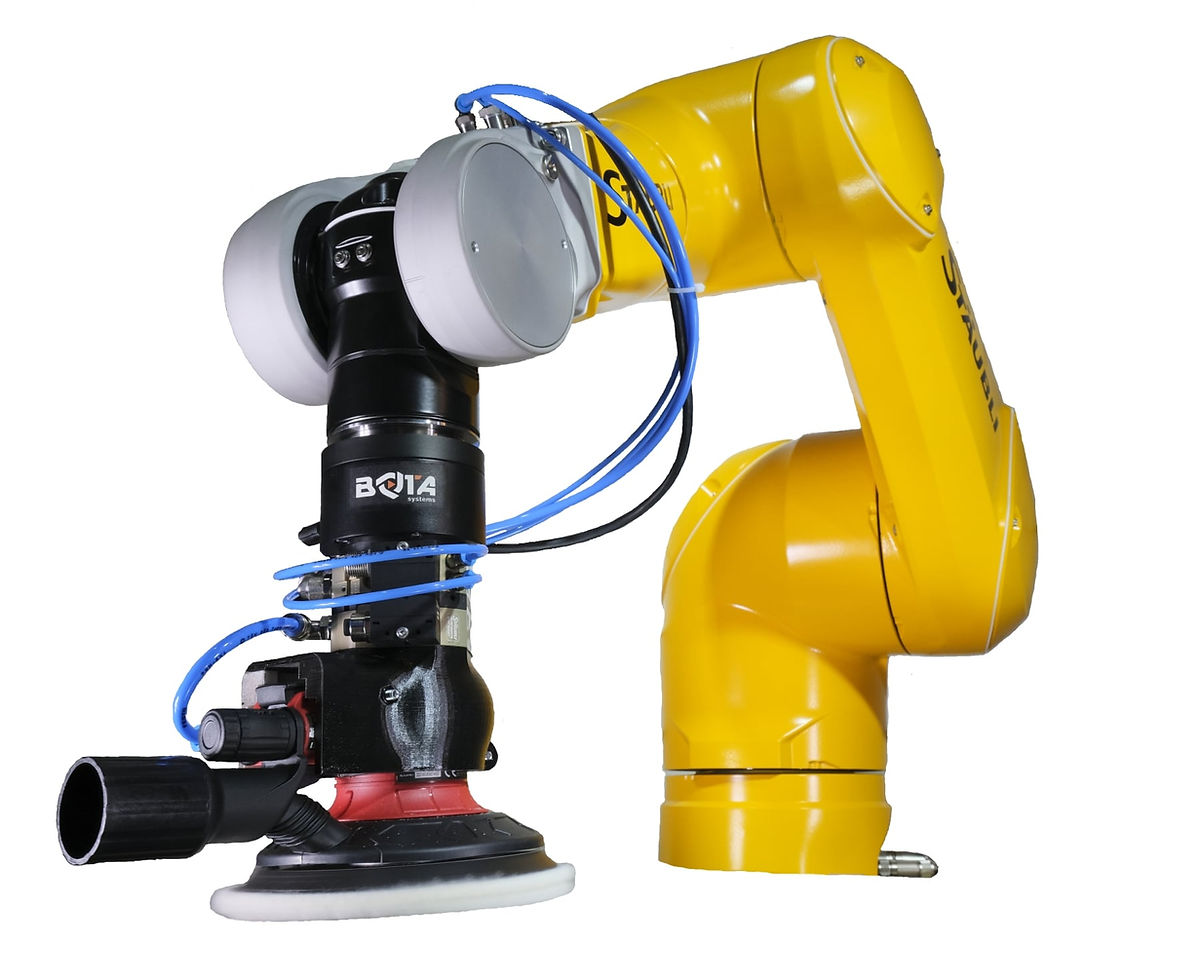
Bota Systems is at the forefront of innovation in the field of force-torque sensors. Their expertise lies in developing and manufacturing high-precision sensors that empower robots with a crucial human sense – touch.
These multi-axis sensors go beyond simply enabling robots to see and navigate their environment. By incorporating Bota Systems’ technology, robots gain the ability to interact with objects with exceptional dexterity and control.
This advancement unlocks a vast array of applications. From ensuring robots handle delicate parts in assembly lines with utmost precision to enabling next-generation prosthetics to deliver a more natural user experience, Bota Systems’ sensors are pushing the boundaries of robotics and automation.
In a nutshell: What is a Sensor?
In this article we answered the question ‘what is a sensor’ and laid out the mechanism behind various sensing technologies.
Sensors are the silent workhorses of our technological age, acting as the bridge between the physical and digital worlds.
From the delicate dance of a robotic arm to the weather monitoring systems that keep us safe, a diverse array of sensors play a crucial role in how we interact with and understand the world around us.
Bota Systems, with their pioneering force-torque sensors, exemplifies the constant push for even more sophisticated sensing capabilities