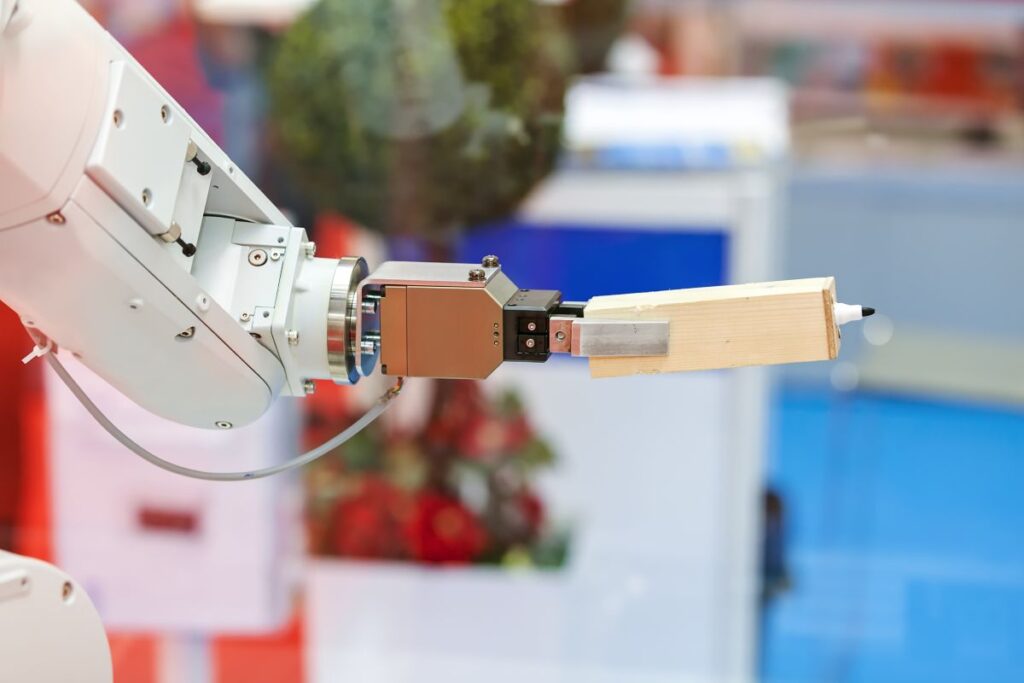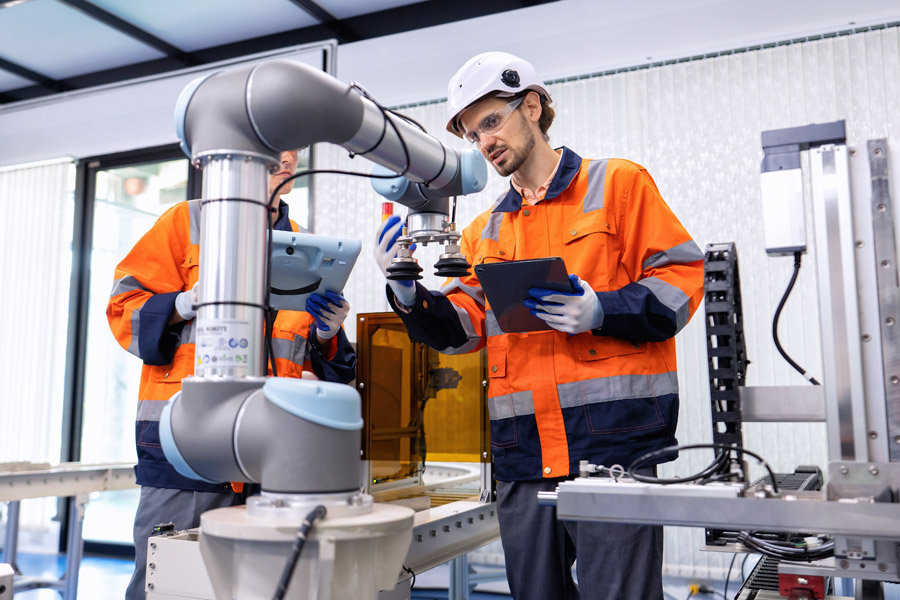
For robots to interact with the world and complete tasks as effectively as humans, they need more than just programming and processing power.
Just like our own five senses, sensors in robotics allow machines to perceive their environment, gather data, and make informed decisions. These sensors play a crucial role in robot navigation, object manipulation, and even communication.
But what types of sensors in robotics are there, and how do they work? How do robots use these sensors to accomplish tasks?
In this article, we’ll answer these questions as we explore the diverse types of sensors in robotics, their applications across different industries, and the crucial role they play in our evolving relationship with automation.
How do Robot Sensors Work?
In essence, all robotic sensors operate on the fundamental principle of transduction, which is the conversion of one form of energy into another.
The specific type of energy is measured and the corresponding output signal varies depending on the robotic sensor. For instance, a temperature sensor might utilize the change in resistance of a material due to heat (electrical to electrical), while a camera converts light energy into electrical signals (optical to electrical).
Regardless of the specifics, the core concept remains the same: the sensor detects a physical phenomenon, transforms it into an electrical signal, and transmits this information for further processing and interpretation.
This processed data becomes the sensory input that allows robots and other automated systems to perceive and interact with the world around them.
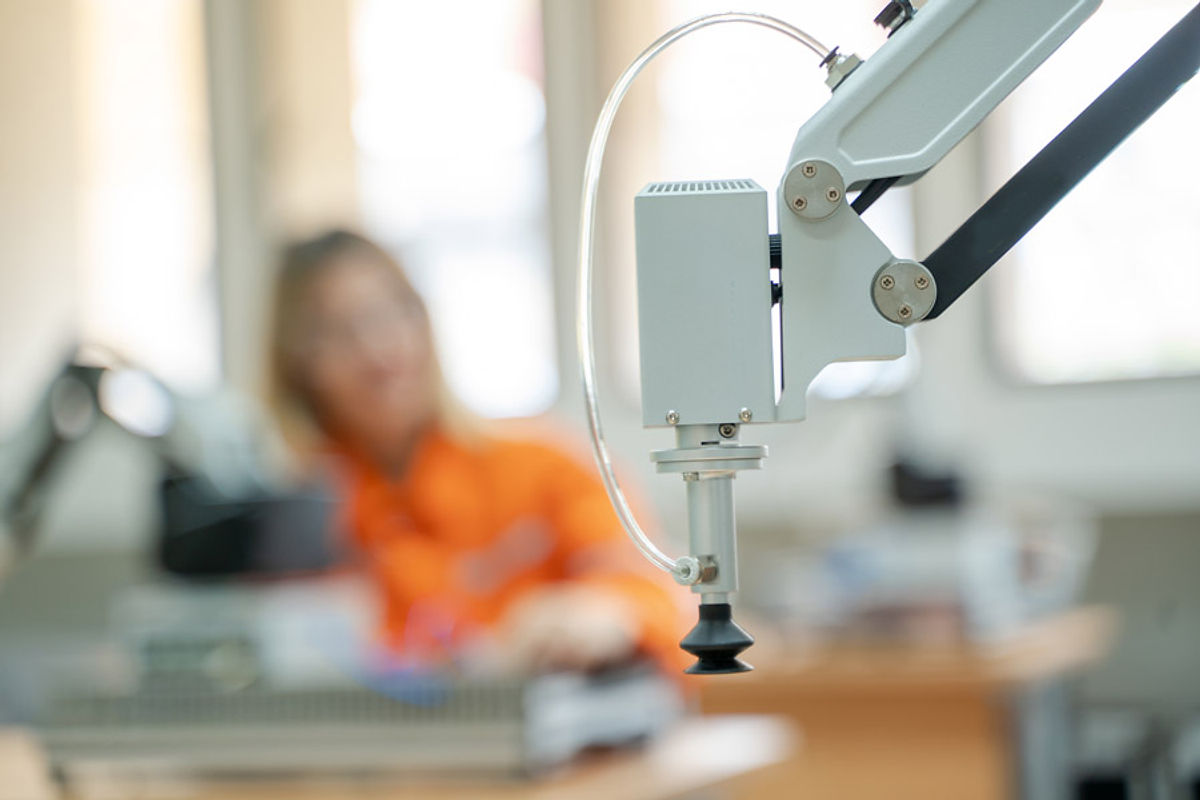
Types and Application of Robot Sensors
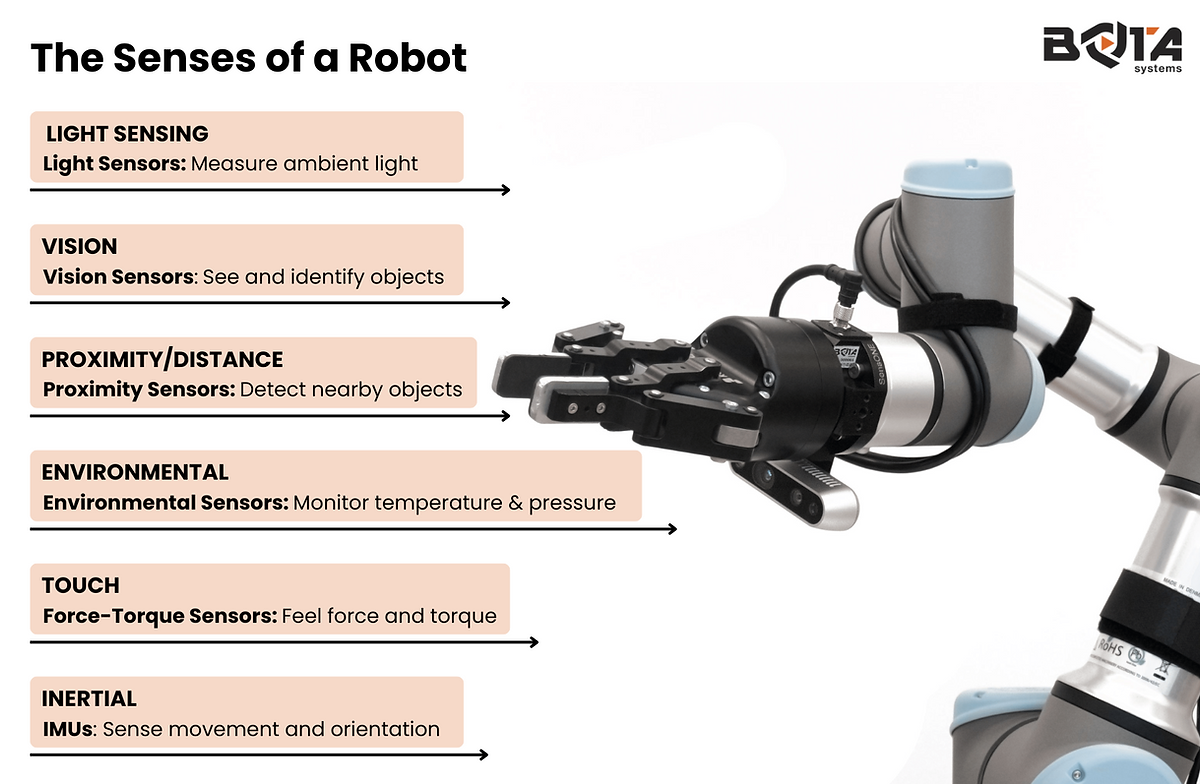
Let’s take a closer look at the major types of sensors in robotics and how robots use them.
Light Sensors
Photoresistors: These are light-dependent resistors whose resistance changes based on the intensity of light they receive. As the light intensity increases, the resistance decreases, and vice versa. This change in resistance can be measured by the light-sensing robot’s control system to determine the light level in the environment.
Photodiodes: These semiconductor devices convert light into an electrical current. The amount of current generated is proportional to the intensity of the light falling on the photodiode. This allows light-sensing robots to not only detect the presence of light but also measure its intensity.
Phototransistors: Similar to photodiodes, these light-sensitive transistors utilize light to control the flow of current through the device. By measuring the change in current, robots can detect the presence or absence of light.
Applications of Light Sensors:
The versatility of light sensors makes them valuable for various robotic tasks, including:
Obstacle avoidance: Robots equipped with light sensors can detect changes in light intensity caused by obstacles, enabling them to navigate safely and avoid collisions.
Line following: By following a line with contrasting light reflectance, robots can navigate along specific paths in factories or other controlled environments.
Light level monitoring: Light sensors can be used to measure ambient light conditions and trigger actions accordingly, such as turning on headlights in low-light situations or adjusting camera settings for optimal image capture.
Object detection: In certain scenarios, light sensors can be used to distinguish between objects based on their reflective properties, aiding in basic object identification tasks.
Vision Sensors
Cameras: Similar to our eyes, cameras capture light information using image sensors. This data is then processed to create a digital image, enabling robots to “see” their surroundings and identify objects.
LiDAR: This technology utilizes lasers to measure the distance to objects by emitting a pulsed beam and detecting the reflected light. By calculating the time it takes for the light to travel, LiDAR creates a 3D map of the environment.
Application of vision robotic sensors:
Cameras act as robot eyes, enabling them to recognize objects, navigate, manipulate objects, inspect products, and interact with humans through visual cues.
Robots can distinguish objects, classify them based on their visual features, and even read labels or codes. Object identification is mainly done by AI algorithms nowadays.
Also, by processing visual data, robots can map their environment, navigate autonomously, and safely avoid obstacles in their path. Moreover, vision robot sensors in fusion with force sensors guide robots in precisely grasping and manipulating objects, ensuring accurate handling and avoiding damage.
Proximity and Distance Sensors:
Infrared (IR) Sensors: These emit and detect infrared radiation, which is invisible to the human eye. By measuring the reflected or received IR waves, they can determine the presence and proximity of nearby objects without physical contact.
Ultrasonic Sensors: Inspired by nature’s echolocation, these robot sensors emit high-frequency sound waves and measure the time it takes for the echo to return. This allows them to calculate the distance to objects within their range.
Application of Proximity and Distance Sensors
These sensors help robots avoid collisions and navigate their surroundings by:
Detecting nearby objects without physical contact.
Measuring the distance to obstacles and other objects.
Enabling safe navigation in various environments.
Environmental Sensors:
Temperature Sensors: These devices convert temperature changes into electrical signals using various principles like thermistors or resistance temperature detectors (RTDs). This information helps robots monitor ambient temperature for tasks like environmental control or preventing overheating.
Pressure Sensors: By measuring the force exerted on a specific area, pressure sensors can detect various factors like object grasping force, fluid pressure, or even ground conditions. They often utilize piezoelectric materials that generate an electrical voltage proportional to the applied pressure.
Application of environmental sensors
These robot sensors monitor various environmental factors, allowing robots to:
Adapt to changing conditions like temperature or pressure. For instance, temperature sensors are frequently used for over-heat protection and pressure sensors for terrain sensing
Gather data for tasks like environmental monitoring or robot health.
Make informed decisions based on the surrounding environment.
Inertial Measurement Units (IMUs):
These compact devices combine multiple robotic sensors like accelerometers, gyroscopes, and sometimes magnetometers.
Accelerometers: Measure the robot’s acceleration in different directions, enabling it to sense movement, tilt, and vibration.
Gyroscopes: Detect the rate of rotation around an axis, helping robots maintain balance and stability.
Magnetometers: Sense the Earth’s magnetic field, providing robots with directional information for navigation purposes.
Applications of IMUs:
The combined data from these robot sensors empowers robots in various ways:
Navigation and stabilization: IMUs are essential for robots to maintain their balance and orientation during movement, enabling tasks like autonomous navigation, drone flight control, and self-balancing robots.
Motion tracking and control: By providing data on acceleration and rotation, IMUs enable precise motion tracking and control for tasks like robotic arm manipulation or object grasping.
Dead reckoning: In situations where GPS is unavailable, IMUs can be used for dead reckoning, estimating the robot’s position based on its previous movements and sensor data.
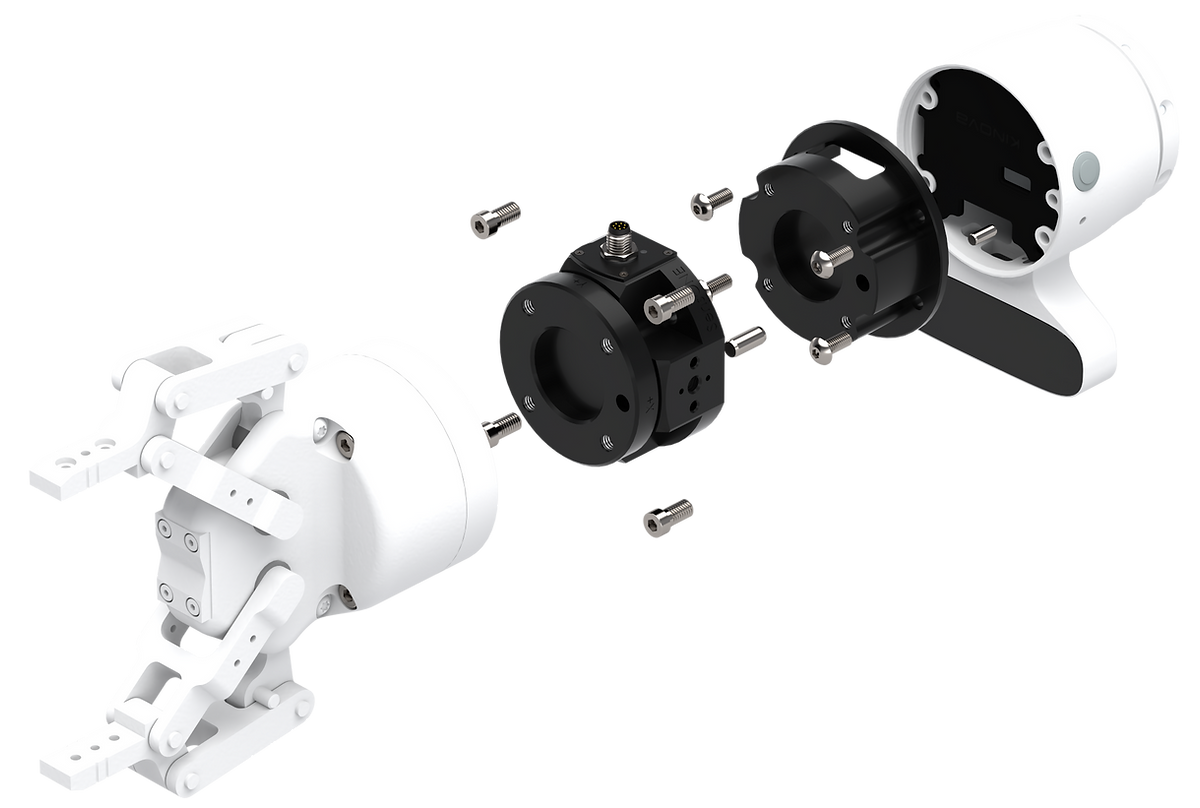
Force-Torque Sensors:
These specialized sensors in robotics act as the “touch” of robots, enabling them to perceive and respond to the forces and torques applied to them.
Force-torque robotic sensors typically utilize various technologies like strain gauges or piezoelectric elements. When a force or torque is applied to the robotic sensor, these elements experience physical deformation, which translates into an electrical signal. The magnitude of this signal corresponds to the intensity of the applied force or torque.
This information is crucial for tasks like delicate object manipulation, safe human-robot interaction, and terrain sensing.
Applications of Force-Torque Sensors:
The ability to sense force and torque unlocks a wide range of applications for robots enabling them to:
Handle delicate objects with precision, preventing damage during manipulation.
Collaborate safely with humans by adjusting movements based on exerted forces.
Perform surface finishing tasks with consistent pressure for optimal results.
Navigate rough terrain by sensing ground conditions and adapting movements.
Enhance surgical precision and safety by providing feedback on applied forces during procedures.
The Power of Touch: Bota Systems and Force-Torque Sensors
In the realm of robot perception, the sense of touch plays a vital role in enabling safe and precise interactions with the physical world.
Companies like Bota Systems are at the forefront of this field, developing high-performance and cost-effective force-torque sensors like the LaxONE and SensONE.
These sensors empower robots to measure the forces and torques applied to them, allowing for delicate object manipulation, safe human-robot collaboration, enhanced surface finishing, and improved terrain sensing capabilities.
Bota Systems’ commitment to affordability and user-friendly solutions makes their force-torque technology accessible to a wider range of industries, fostering the integration of this crucial sensory modality into diverse robotic applications.
Get in touch to find a force-torque sensor solution for robotic needs.
Conclusion
From the intricate “eyes” of vision sensors to the sensitive “touch” of force-torque sensors, different robot sensors equip robots with the perception needed to navigate, interact, and adapt to the complexities of the real world.
As sensor technology continues to evolve and converge with advancements in artificial intelligence, robots will gain even more sophisticated sensory capabilities.