Baud rate is the number of signal changes transmitted per second in a communication channel. It is a key setting in UART, RS-232, RS-485, Modbus, and embedded systems because mismatched baud rates can cause communication failure.
Imagine trying to have a conversation where you can only speak one word every few seconds—communication would be painfully slow and frustrating. This is essentially what happens in digital communication when the baud rate is too low.
The baud rate is the speed at which data is transmitted between devices, and getting it right is crucial for smooth, efficient communication.
What is the Baud Rate?
Baud rate refers to the number of symbols or signal changes transmitted each second across a communication channel. It measures signaling speed rather than the total number of bits transferred.
Unlike bit rate, which measures bits per second (bps), baud rate measures how often the signal changes each second. In some systems these values are the same, while in others each symbol may carry multiple bits.
For instance, a baud rate of 9600 means that 9600 signal changes occur every second. Depending on the encoding scheme, each signal change might represent more than one bit of data, making the baud rate a critical parameter in digital communications.
Baud Rate vs Bit Rate vs Frequency
It’s easy to confuse baud rate with frequency, but they measure different aspects of communication. While frequency refers to the number of cycles per second (measured in Hertz), baud rate refers to the number of signal changes per second. In many digital systems, the two are closely related, but they are not interchangeable.
The key difference lies in how data is encoded. For example, if each signal change (baud) represents a single bit, the baud rate and bit rate are the same. However, in more complex systems where each baud represents multiple bits (due to advanced modulation techniques like QAM), the bit rate can be much higher than the baud rate.
Calculating Baud Rate
To calculate baud rate, you need two pieces of information:
Bit rate: The number of bits transmitted per second.
Bits per symbol: The number of bits represented by each signal or symbol.
The baud rate can be calculated using this formula:
Baud Rate = Bit Rate / Bits per Symbol
Example: If a system transmits data at 2400 bits per second and each symbol represents 2 bits, the baud rate is 1200 baud.
Baud Rate = 2400 bits/second / 2 bits/symbol = 1200 baud
Typical and Standard Baud Rates
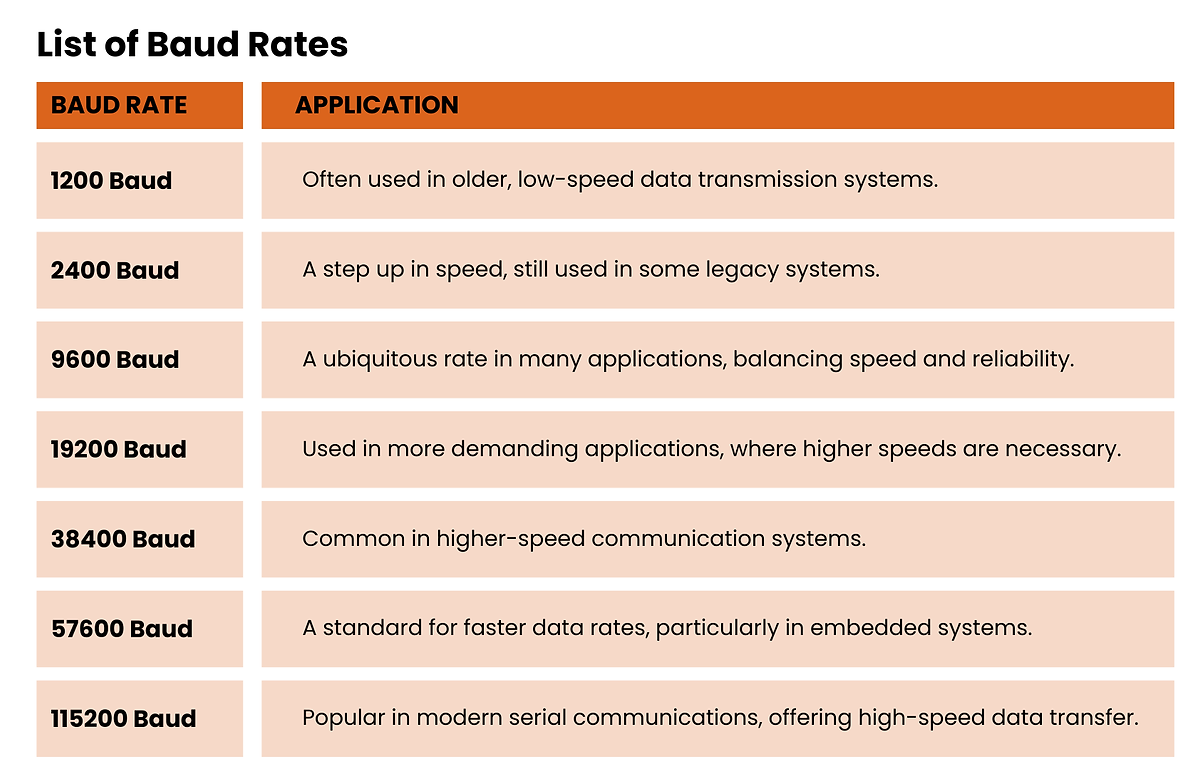
In the world of digital communication, not all baud rates are created equal. Some rates have become standard across various industries and applications, making them go-to choices for engineers and developers.
These standard baud rates, like 9600, 19200, 38400, and 115200, are commonly used in communication protocols such as RS-232, UART, and other serial communication systems.
Why these specific rates? It often comes down to a combination of historical precedence and practical considerations. For example, 9600 baud is widely used because it strikes a good balance between speed and reliability, particularly in older or slower communication systems.
Higher rates like 115200 baud are preferred in more modern applications where faster data transfer is needed and the communication link is robust enough to handle it.
Baud Rate in Serial Communication Systems
UART and Serial Communication
Baud rate plays a critical role in UART (Universal Asynchronous Receiver-Transmitter) communication, a cornerstone of serial communication in embedded systems. UARTs are widely used in microcontrollers, PCs, and various types of serial devices to facilitate data exchange.
When devices communicate via UART, the UART baud rate must be precisely matched between the transmitter and receiver. If there’s a mismatch, the data can become corrupted, leading to communication errors or complete failure of the system.
In a typical UART communication setup, data is transmitted one bit at a time over a single wire, with each bit being clocked out at the baud rate. For example, if two devices are communicating at 9600 baud, they must synchronize timing at the same signaling rate. In simple UART systems, this often approximates 9600 bits per second.
This synchronization is essential for ensuring that both devices correctly interpret the data being sent and received.
Common UART Setting Example
A common serial configuration is 115200 8N1, meaning:
- 115200 baud
- 8 data bits
- No parity
- 1 stop bit
Baud Rate and Data Integrity
The choice of baud rate directly impacts data integrity in communication systems. Higher baud rates allow for faster data transmission but can increase the likelihood of errors, especially in noisy environments or over long distances. This is because higher baud rates shorten the duration of each signal change, making the system more susceptible to timing errors and interference.
In applications where data integrity is paramount—such as in medical devices, automotive systems, or critical industrial controls—engineers often opt for lower baud rates to ensure more robust communication. However, advances in error correction techniques and signal processing have allowed higher baud rates to be used more reliably in many modern systems.
How to Choose the Right Baud Rate
Selecting the appropriate baud rate for your communication system involves several considerations:
Communication Distance
Over long distances, higher baud rates are more prone to signal degradation. Lower baud rates are often chosen to maintain data integrity over extended cable runs or in environments with significant electrical noise.
Noise and Interference
In noisy environments, such as industrial settings with heavy machinery, higher baud rates can be more susceptible to errors. It’s crucial to consider the noise levels when choosing a baud rate, as lower rates can help ensure cleaner communication.
Required Data Rate
If your application demands high-speed data transfer, a higher baud rate may be necessary. However, this needs to be balanced with the capabilities of your hardware and the quality of your communication channel.
Hardware Limitations
Not all devices or communication channels support all baud rates. It’s essential to ensure that your hardware can handle the chosen baud rate without introducing errors or data loss.
Protocol and Standard Requirements
Some communication protocols or standards may dictate specific baud rates. Adhering to these requirements is important for compatibility and compliance.
Benefits of Higher Baud Rates
Higher baud rates offer several advantages when speed is important:
Faster Data Transmission: The most obvious benefit of a higher baud rate is increased data throughput. This is essential in applications where large amounts of data need to be transmitted quickly, such as in real-time video streaming or high-speed data logging.
Improved System Performance: Higher baud rates can reduce latency in communication systems, leading to more responsive interactions between devices.
Efficient Use of Bandwidth: In systems where bandwidth is limited, using higher baud rates with efficient encoding schemes can maximize the amount of data transmitted within the available spectrum.
However, these benefits come with trade-offs. Higher baud rates require more precise timing and are more sensitive to noise and signal degradation. It’s crucial to weigh these factors against the specific needs of your application.
Common Baud Rate Problems and Fixes
Despite careful planning, baud rate issues can still arise, particularly in complex or noisy communication environments. Here are some common problems related to baud rate and how to address them:
Baud Rate Mismatch
Problem: When the transmitting and receiving devices are set to different baud rates, data can become garbled or lost entirely.
Solution: Ensure that all devices in the communication chain are configured to use the same baud rate. Double-check settings in both hardware and software configurations to avoid mismatches.
Transmission Errors
Problem: Higher baud rates can result in increased transmission errors, especially over long distances or in electrically noisy environments.
Solution: Consider lowering the baud rate to reduce errors. Additionally, use shielded cables and error-correcting protocols to improve communication reliability.
Data Corruption
Problem: Signal degradation or timing issues can lead to data corruption, where the received data differs from what was sent.
Solution: Use robust error-checking mechanisms, such as checksums or CRCs (Cyclic Redundancy Checks), to detect and correct errors. If issues persist, lowering the baud rate or improving the quality of the communication medium may be necessary.
Buffer Overflows
Problem: At higher baud rates, data may be transmitted faster than the receiving device can process, leading to buffer overflows and lost data.
Solution: Optimize your system’s buffer management, or reduce the baud rate to ensure that the receiving device can keep up with the data flow.
Best Practices
To minimize baud rate issues and ensure reliable communication, follow these best practices:
Start with Standard Rates: Use common, well-supported baud rates like 9600 or 115200 when possible, as they are widely tested and supported across various devices.
Test Thoroughly: Before deploying your system, conduct thorough testing under real-world conditions to ensure that the chosen baud rate performs reliably.
Use Quality Components: Invest in high-quality cables, connectors, and devices that are designed to operate reliably at the chosen baud rate.
Document Settings: Keep detailed records of all baud rate settings and related configurations to make troubleshooting easier if issues arise.
By following these practices, you can significantly reduce the likelihood of encountering baud rate-related issues and maintain a stable and efficient communication system.

Conclusion
Baud rate is a core concept in digital communication that affects speed, reliability, and device compatibility. Whether you are configuring UART devices, industrial sensors, or embedded systems, choosing the correct baud rate helps ensure stable performance and accurate data transfer.
Reliable Communication for Robotics and Automation
At Bota Systems, we recognize the importance of reliable communication in automation and robotics. Our state-of-the-art sensor solutions are designed with precision and dependability in mind, ensuring that they perform optimally in any application, even under challenging conditions.
Optimize your communication systems with Bota Systems’ advanced sensor technology. Our force torque sensors are engineered to provide accurate, real-time data, enabling seamless integration with your existing systems. Whether you’re working on industrial automation, robotics, or any other high-demand application, our sensors deliver the performance you need to succeed.
Contact Bota Systems today to learn more about our high-performance sensors and how they can help you achieve unparalleled reliability and precision in your projects.
FAQs About Baud Rate
What does 9600 baud mean?
It means the signal changes 9,600 times per second. In many simple serial systems, this often corresponds closely to 9,600 bits per second.
Is baud rate the same as bit rate?
No. Baud rate measures symbols per second, while bit rate measures bits per second.
What happens if baud rates do not match?
Devices may fail to communicate correctly, resulting in corrupted or unreadable data.
Is higher baud rate always better?
Not always. Higher baud rates increase speed but may reduce reliability over long distances or noisy environments.