The rise of automation and robotics in industries has brought significant advancements in precision, efficiency, and flexibility.
Among the various types of industrial robots, the 6-axis robot stands out for its remarkable versatility and range of motion, making it a staple in many manufacturing environments.
But what exactly is a six-axis robot, and what makes it so valuable?
This article will explore the structure, applications, and benefits of six-axis industrial robots, shedding light on why they are a go-to solution for industries worldwide.
What is a 6 Axis Robot?
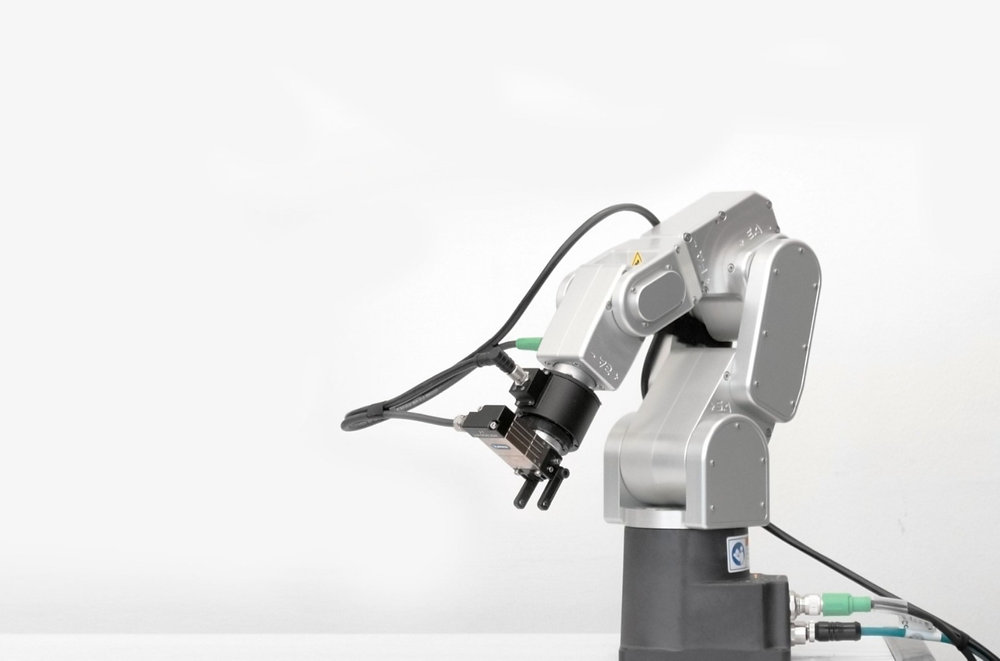
A 6-axis robot is an industrial robot designed with six degrees of freedom (DOF), meaning it can move in six different ways.
These 6 dof robots typically feature an articulated arm with multiple joints that allow motion across various axes. The six axes correspond to different types of movement as explained in figure 1.
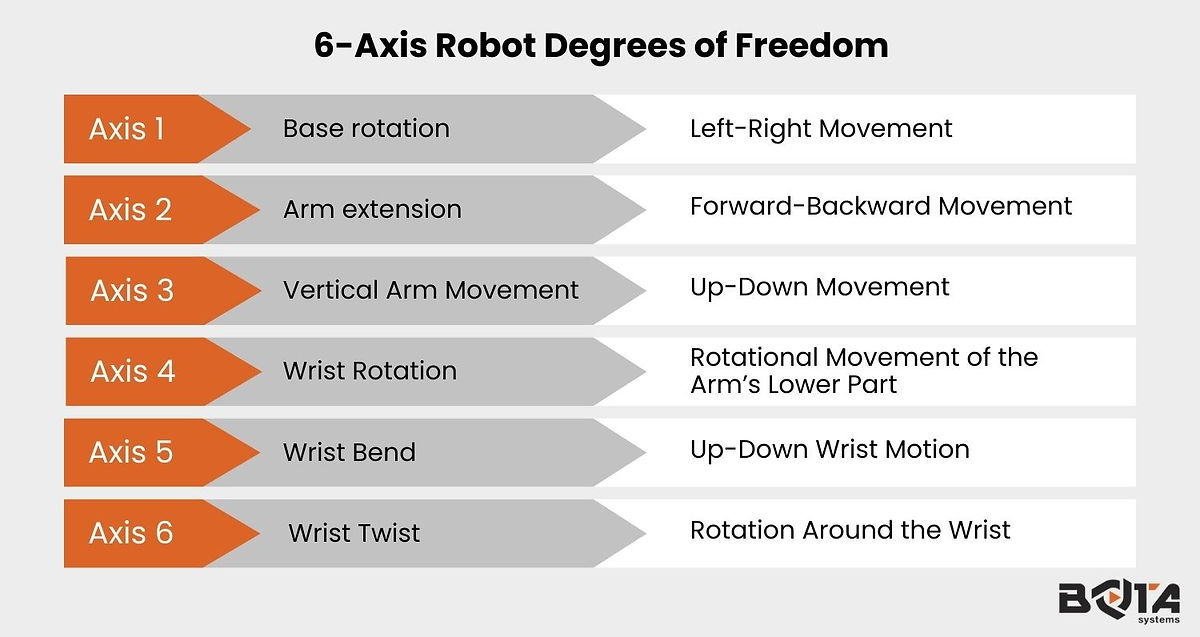
This configuration gives 6 axis robots exceptional dexterity, allowing them to perform tasks that require a high degree of precision and complexity.
They can mimic the range of motion of a human arm, making them ideal for various applications that need precision and adaptability.
Components of a Six-Axis Robot
A six-axis robot is a highly engineered piece of technology, built to handle complex tasks with precision and flexibility.
Its design consists of several key components, each contributing to its multi-degree-of-freedom movement and overall functionality. This section will break down these components and delve into their technical aspects.
1. Base
The base is the foundation of the 6-axis robot, typically mounted on a stable surface like the floor or a pedestal. The base often contains a rotary motor coupled with high-torque reducers, such as harmonic drive gear systems or cycloidal drives.
These components allow precise control over the robot’s rotational motion while offering high load-bearing capacity.
The base is also where Axis 1 is located, which allows for the rotational motion of the robot’s arm about the vertical axis.
2. Linkages and Joints
The structure of a 6-axis robot is composed of linkages (rigid components) connected by joints (rotational or prismatic).
These joints provide the robot with its degrees of freedom. Each joint is associated with an independent axis, allowing motion relative to the adjacent links.
3. Servo Motors
Servo motors are responsible for providing precise motion control to each axis of the six-axis robot. Each axis typically has its own servo motor, allowing independent control and movement.
These motors are highly responsive and offer precise torque, speed, and positional control within a closed-loop control system. The closed-loop system relies on feedback from encoders or resolvers, which continuously monitor the position, velocity, and torque of the motor.
In high-precision robots, brushless AC servo motors are preferred for their high torque-to-weight ratio and efficient heat dissipation, which is crucial for continuous operation.
4. Gearboxes
Reducers or gearboxes are essential for translating the high-speed, low-torque output of the servo motor into the high-torque, low-speed motion required for most robotic tasks.
The type of gearbox varies depending on the axis, but common ones include harmonic drives and planetary gearboxes.
Harmonic Drives: Used for axes requiring extreme precision and minimal backlash, such as Axis 5 and Axis 6. Harmonic drives can achieve reduction ratios up to 1:160 in a compact form factor.
Planetary Gearboxes: These are typically used for the main arm’s axes (Axis 1 to Axis 3) because they offer high torque transmission in a relatively compact design.
The reducers are crucial for managing the robot’s payload capacity and maintaining smooth, controlled movements.
The efficiency of the gearbox determines the overall system’s energy consumption and accuracy.
5. Encoders and Sensors
Encoders and sensors provide crucial feedback to the robot’s control system, ensuring precise movement and positioning.
Encoders are typically mounted on each motor shaft and joint to track the angular position of the axis in real-time.
Force-Torque Sensors are integrated into the wrist joint (Axis 6) to measure the force applied by the end-effector. This is particularly useful in assembly tasks where delicate interaction with the environment is required.
Sensors are also used for collision detection, vibration monitoring, and temperature regulation, helping the robot to operate safely and efficiently.
6. End-Effector
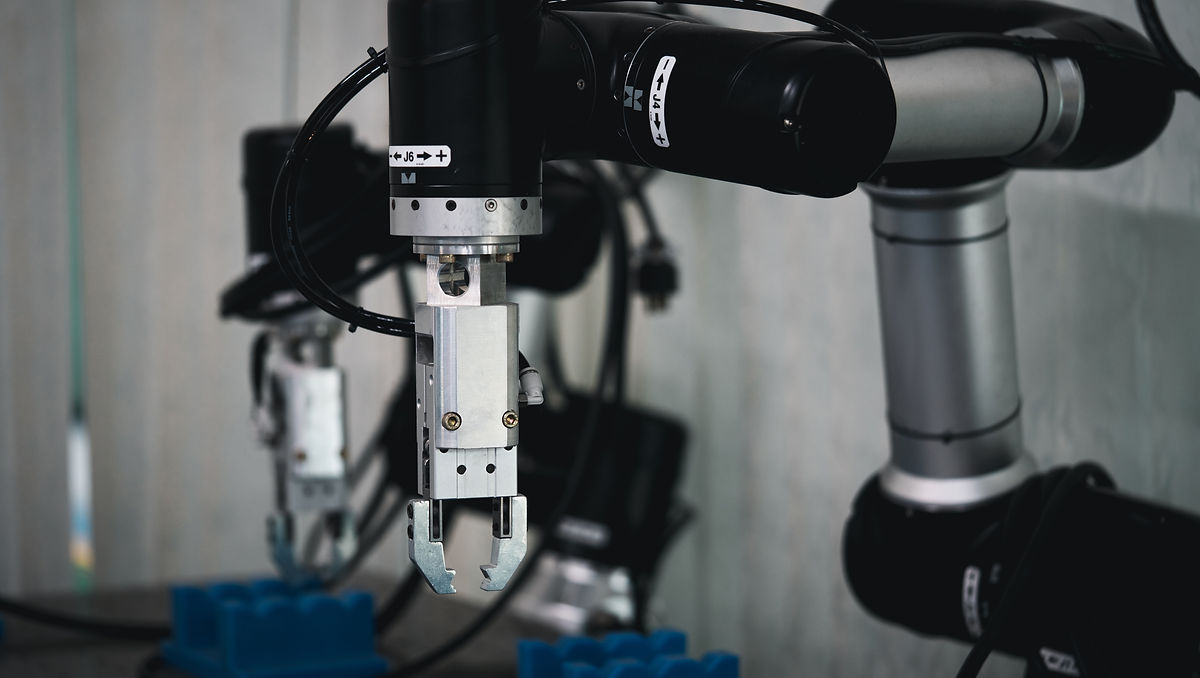
The end-effector is the tool or device attached to the 6-axis robot’s wrist that interacts with the environment.
Common end-effectors include grippers, welding torches, screwdrivers, and vacuum suction devices.
7. 6 Axis Robot Arm Controller
The robot arm controller is the brain of the six-axis robot, coordinating the movement of all axes based on input commands.
Modern controllers are often programmable logic controllers (PLCs) or dedicated robotic controllers, capable of real-time processing of motion trajectories, speed, and torque adjustments.
Controllers also handle safety functions such as emergency stops, collision avoidance, and error recovery.
8. Power Supply
The power supply system of a six-axis robot converts electrical energy into usable power for the servo motors, controllers, and sensors.
It must provide a stable and reliable supply of energy, as any fluctuations can lead to inaccuracies or faults in the robot’s operation.
Applications of Six-Axis Robots
Due to their flexibility and precision, six-axis robots find applications across a wide range of industries, including manufacturing, healthcare, and even education. Below are some common uses:
1. Welding and Assembly
One of the primary uses of six-axis industrial robots is in welding and assembly lines. Their ability to move in multiple directions allows them to precisely weld intricate parts or assemble components that require detailed alignment.
These robots are commonly used in the automotive industry, where high precision and repeatability are essential.
2. Material Handling
Six-axis robots excel in material handling tasks, such as loading and unloading parts from machines, packaging products, and moving heavy or delicate objects.
Their advanced motion capabilities ensure that materials are handled carefully, reducing the risk of damage or errors during production.
3. Painting and Coating
The flexibility of six-axis robots makes them ideal for tasks such as painting and surface coating.
The robots can follow complex paths and maintain a consistent speed and pressure, ensuring an even application of paint or coating across different surfaces. This is particularly important in industries like aerospace, where consistency is crucial.
4. Pick-and-Place Operations
Pick-and-place operations involve selecting objects from one location and placing them in another.
Small 6-axis robots or miniature 6-axis robots are often used in electronic component manufacturing or pharmaceuticals, where precision handling of tiny or fragile items is required. These robots can work with extreme accuracy, ensuring minimal waste and defects.
5. Machine Tending
Machine tending involves operating or overseeing the function of manufacturing machines, such as CNC machines, injection molders, or presses.
A six-axis robotic arm can easily handle these tasks by loading raw materials, monitoring machine operations, and removing finished parts, thus reducing downtime and increasing production efficiency.
6. Inspection and Quality Control
In industries where quality control is critical, 6-axis robots equipped with sensors and cameras can inspect products for defects or inconsistencies.
Their ability to move precisely around a product ensures thorough inspections from multiple angles, which is especially useful in industries such as electronics or pharmaceuticals.
Benefits of Six-Axis Robots
The popularity of six-axis robots stems from their numerous advantages over other types of robots, including three-axis or four-axis models. Six-axis robots offer significant benefits in industrial applications due to their exceptional flexibility, precision, and efficiency.
With six degrees of freedom, they can mimic human arm movements, enabling a wide range of complex tasks such as welding, assembly, material handling, and inspection. Their ability to operate continuously without fatigue boosts productivity while maintaining consistent quality and minimizing errors.
Six-axis robots are space-efficient, with compact models available for smaller environments, and though the initial investment may be high, their long-term cost savings and versatility across multiple tasks provide an excellent return on investment.
Additionally, the precision and repeatability of six-axis robots reduce waste and rework, further enhancing cost-effectiveness in high-demand production settings.

Bota System’s Force Torque-Sensing Technology
Bota Systems has positioned itself as a leading producer of advanced multi-axis force-torque sensors that are designed to integrate with robotic systems, enhancing their functionality and precision.
Their sensors, like the SensONE and MiniONE Pro, allow robots to perform tasks that require sensitivity to force and torque, making them ideal for applications in delicate assembly, material handling, and high-precision automation.
These sensors are compatible with various robotic brands and enable real-time haptic feedback, positioning Bota Systems as a critical component supplier in collaborative and industrial robotics
Conclusion
The six-axis robot has revolutionized automation across multiple industries, offering unprecedented flexibility, precision, and efficiency.
Whether it’s for welding, material handling, or inspection, these robots deliver results that improve productivity while maintaining high standards of quality.
From small industrial robot arms to large-scale applications, the versatility of six-axis robots is undeniable, and their use will continue to grow as more industries recognize the benefits they offer.
If you’re in the market for a 6-axis robotic arm kit or considering automation in your operations, now is the time to explore the various options available. With advancements in robot control systems and affordability, a six-axis robot could be the key to staying competitive in today’s fast-paced industrial landscape.