Torque is the rotational force that causes an object to turn around an axis or pivot point. In simple terms, torque is the twisting power that helps engines move cars, tools turn bolts, and robot joints lift or rotate objects. It is one of the most important concepts in mechanics, automotive engineering, and robotics.
Have you ever wondered why some cars accelerate quickly, why trucks pull heavy loads, or how robotic arms move with strength and precision? The answer is torque.
In this guide, you’ll learn what torque is, how torque works, the torque formula, and why torque matters in cars, machines, and modern robotic systems.
What is torque?
Torque is the rotational force that causes an object to turn around an axis. It is calculated as force multiplied by distance from the pivot point. Torque is measured in Newton-meters (Nm) or pound-feet (lb-ft).
How does torque work?
For an object to accelerate in linear kinematics, force is responsible. A similar relationship applies to angular acceleration, which is generated by torque.
Thus, torque can be thought of as the equivalent of linear force in the context of rotation.
Now let’s define torque in simple terms. It’s a twisting force that causes an object to rotate around an axis.
Imagine a seesaw: when you push down on one end (applying a force), the other end lifts up (rotates around the central fulcrum). The greater the force you apply and the farther you push from the fulcrum, the greater the torque you create, causing the seesaw to rotate more vigorously.
This principle applies to all rotating objects. The force can be a person pushing a lever, a motor generating power within a machine, or even the wind pushing against the blades of a windmill. The distance from the point of force application to the axis of rotation is known as the moment arm. The longer the moment arm, the greater the torque generated for the same amount of force.
Here’s a simple mathematical torque definition:
Torque = Force x Moment Arm
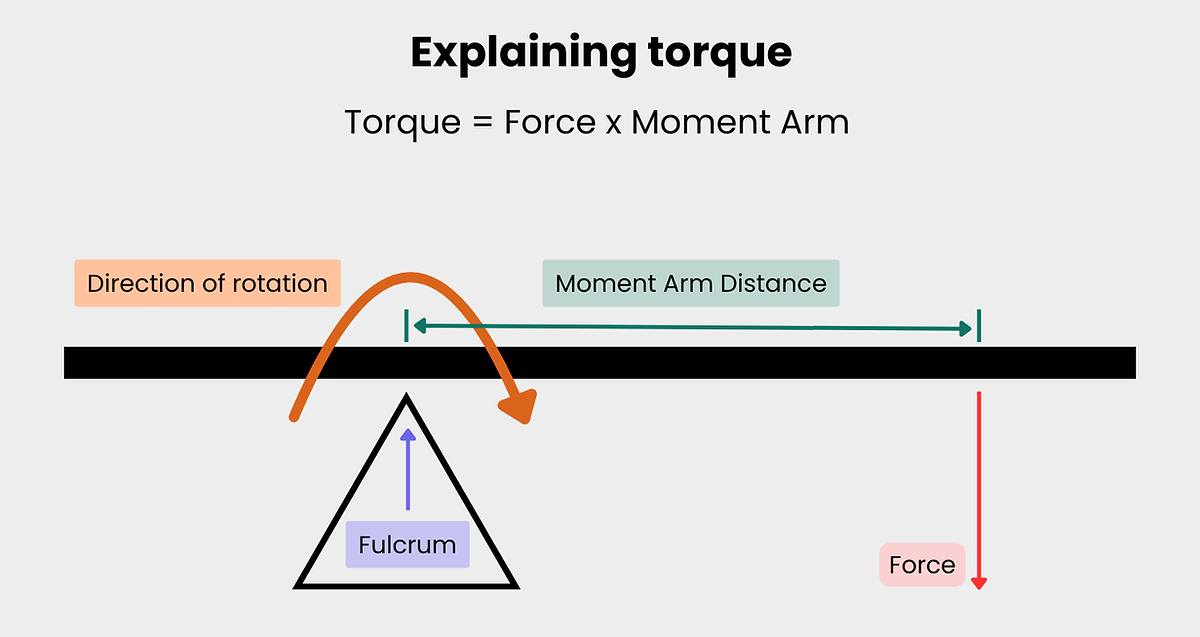
The greater the product of force and moment arm, the higher the torque and the stronger the rotational effect.
Torque units: Nm vs lb-ft
Torque is expressed in two main units depending on the industry and region:
| Unit | Full name | Common use | Conversion |
|---|---|---|---|
| Nm | Newton-meter | International standard, physics, European automotive | 1 Nm = 0.737 lb-ft |
| lb-ft | Pound-foot | US automotive specifications | 1 lb-ft = 1.356 Nm |
Quick reference: multiply lb-ft by 1.356 to get Nm. A car producing 300 lb-ft generates approximately 407 Nm.
Static and Dynamic Torque
Torque can be divided into two main categories based on how force acts over time:
Static Torque
This refers to a constant twisting force applied to an object that doesn’t cause it to rotate.
Imagine holding a wrench to tighten a bolt without actually turning it. The force you apply (torque) is static because it holds the bolt in place but doesn’t initiate rotation.
Understanding static torque is crucial in various applications like bolt tightening, gripping objects with robotic arms, or designing components that need to resist twisting forces without rotating.
Dynamic Torque
This type of torque is a twisting force that causes an object to rotate and continues to act as the object moves.
The engine in a car generates dynamic torque, which is transmitted through the drivetrain and ultimately rotates the wheels, propelling the vehicle forward.
Dynamic torque is the workhorse behind rotational motion in machinery. From engines in vehicles to motors in factories, understanding dynamic torque is essential for analyzing performance, designing efficient systems, and controlling movement.
Don’t confuse force with torque
We have already explained what is torque and provided a pretty clear torque definition, but it can be a lot to take in for someone new to the concept.
It is important to clarify the relationship between force and torque. Force is the pushing or pulling action exerted on an object.
Torque, on the other hand, is the twisting effect this force creates, causing the object to rotate around an axis. It’s essentially a measure of the rotational effectiveness of the applied force.
The greater the force applied and the farther it’s applied from the axis of rotation (longer moment arm), the higher the resulting torque. This is why a wrench positioned further away from the bolt head (longer moment arm) allows you to loosen it with less effort (less force required for the same torque).
In simpler terms, force is the raw muscle, while torque is the resulting twist. They work together: a larger force can generate a higher torque, but the distance from the force application point to the axis (moment arm) also plays a crucial role.
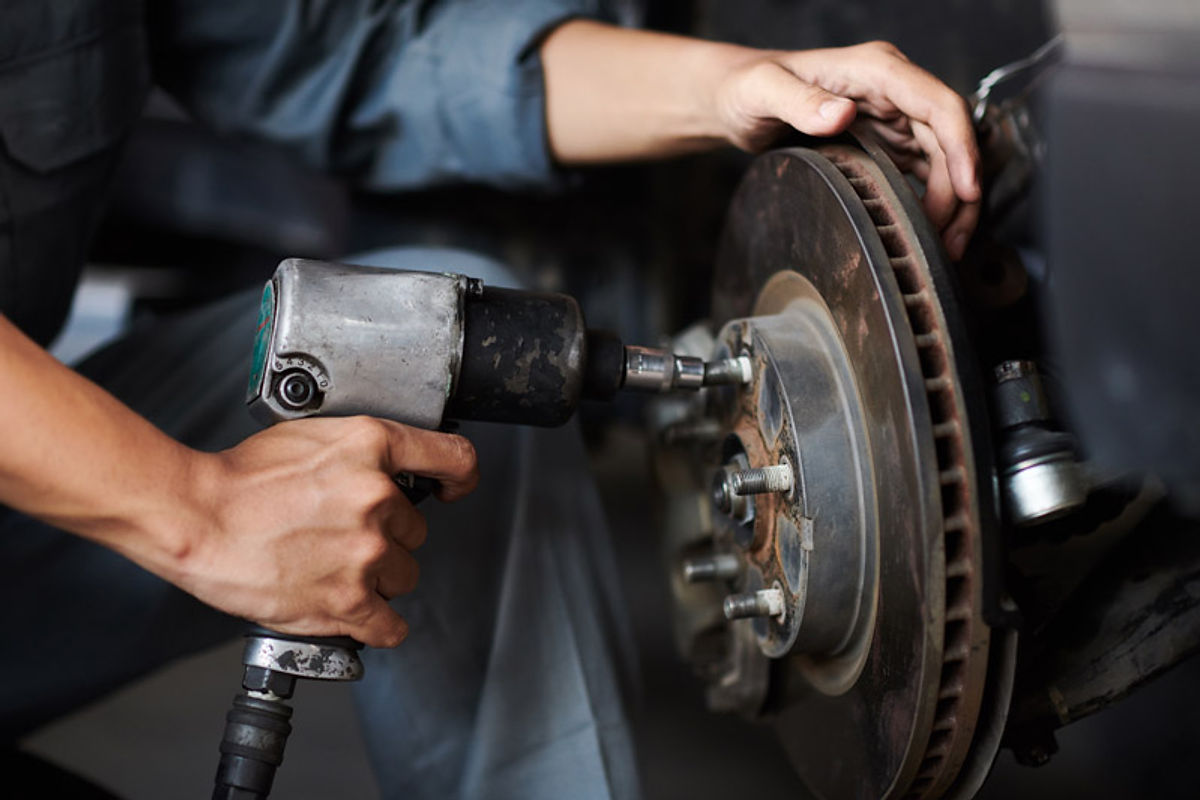
Torque in a car
For car enthusiasts, understanding what is torque unlocks the secrets behind a vehicle’s true potential.
Imagine stepping on the gas pedal. This action instructs the engine to burn fuel and generate torque. This rotational force is then transmitted through the clutch (in manual transmissions) or torque converter (in automatic transmissions) to the drivetrain, ultimately reaching the wheels.
The higher the torque produced by the engine, the greater the twisting force available at the wheels, resulting in:
Faster Acceleration: High torque allows a car to overcome inertia and reach higher speeds in a shorter time. This is why sports cars, known for their quick bursts of speed, typically focus on delivering high torque at higher engine speeds.
Superior Towing Capacity: Trucks, on the other hand, prioritize generating high torque at lower engine speeds. This allows them to tow heavy loads and navigate difficult terrains where strong pulling power is essential.
What is engine torque?
Engine torque, in simpler terms, is the twisting force generated by a car’s engine. It’s the muscle behind the engine’s power, causing the crankshaft to rotate and ultimately propelling the vehicle forward.
Here’s a breakdown of engine torque:
Source: The burning of fuel in the engine cylinders creates a force pushing down on the pistons. This force is then transferred through the connecting rods to the crankshaft, causing it to rotate.
Measurement: Engine torque is typically measured in pound-feet (lb-ft) or newton-meters (Nm). A higher torque rating indicates a greater twisting force produced by the engine.
Impact on Performance: Engine torque directly influences a car’s acceleration and pulling power. Higher torque allows a car to accelerate faster by overcoming inertia (resistance to motion) more readily. Furthermore, by providing the necessary twisting force to move the additional weight, it allows vehicles to tow heavy loads.
Relationship with Horsepower: While engine torque is the twisting force, horsepower is a measure of the rate at which work is done (power output). Think of torque as the engine’s raw muscle and horsepower as its overall work rate. A car with high torque may accelerate quickly from a stop, while a car with high horsepower may excel at maintaining high speeds.
Vehicle torque specs are provided by car manufacturers and are an important factor to consider when choosing a vehicle. They can help you understand:
A car’s suitability for specific driving needs: If you prioritize quick acceleration, you might look for a car with high torque at higher engine speeds. For frequent towing, high torque at lower engine speeds is more crucial.
Fuel efficiency: Cars with high torque at lower engine speeds can sometimes achieve better fuel efficiency.
It’s important to remember that torque specifications are just one piece of the puzzle when evaluating a car’s performance.
Factors like horsepower, weight, and transmission type also play a role. However, understanding torque gives you a strong foundation for interpreting vehicle capabilities and choosing the right car for your specific needs.
Torque vs horsepower
Torque and horsepower are closely related but measure different things. Torque is the twisting force an engine produces; horsepower measures how quickly that force can do work over time.
| Torque | Horsepower | |
|---|---|---|
| What it is | Rotational force — the twisting push | Rate of doing work over time |
| Unit | Nm or lb-ft | hp or kW |
| What you feel | The shove off the line from a stop | The surge at high speed |
| Most important for | Towing, acceleration, off-road | Top speed, sustained performance |
The two are mathematically linked: Horsepower = (Torque × RPM) ÷ 5252
A practical way to remember the difference: torque makes a vehicle quick off the line; horsepower determines how fast it can ultimately go.
Torque in Robotic Applications
Torque control plays a critical role in ensuring the smooth, efficient, and safe operation of robots across various applications. Here’s how:
Precision Manipulation: Delicate tasks like assembling intricate electronics or handling fragile objects require robots to exert precise amounts of force. Precise torque control allows robots to manipulate objects with a gentle touch, preventing damage and ensuring the successful completion of the task.
Joint Movement and Stability: Robots rely on multiple joints for movement. Precise torque control ensures smooth and stable operation of these joints, allowing for accurate positioning and efficient execution of movements. Imagine a robotic arm painting a masterpiece; erratic or uncontrolled joint movements would result in a disastrous outcome. Torque control prevents this by providing the necessary stability and precision.
Force Control and Interaction: When robots interact with the physical world, they encounter external forces. Sensors measuring torque, like those offered by Bota Systems, provide robots with the ability to “feel” these forces. This allows them to adjust their grip strength or movement strategy in real-time, ensuring secure grasping of objects or safe navigation in dynamic environments.
By incorporating force-torque sensors and torque sensors from Bota Systems, robots gain a deeper understanding of the forces they interact with.
These sensors measure not only the force applied but also the resulting torque, providing robots with a more comprehensive picture of their environment. This empowers them to perform tasks with greater precision, adaptability, and safety.
Looking to improve robot precision, safety, or force control? Contact Bota Systems to find the right force-torque sensor for your system.
Humanoid robots
The latest generation of humanoid robots uses high-torque actuators in every joint. Bipedal locomotion requires leg joints to sustain large torques during single-leg stance phases.
Recent humanoid platforms use servos rated at 80–200 Nm per joint to achieve stable walking and load-carrying in real-world environments.
Industrial humanoid robots entering factory environments in 2025–2026 must produce sufficient torque to lift components weighing 5–20 kg while maintaining balance. Torque specification — not reach or speed — is the defining design constraint in this category.
What Is Torque? In a nutshell…
Torque is the twisting force that creates rotational movement. The more force applied, and the farther that force is from the pivot point, the greater the torque produced.
In vehicles, torque helps with acceleration, towing, and climbing hills. In machinery, it powers rotating parts. In robotics, controlled torque enables precision, safety, and smooth motion.
Whether turning a wrench or powering a humanoid robot, torque is what makes rotation happen.
Ready to improve torque control, robotic precision, and force sensing performance? Contact Bota Systems today.
Frequently asked questions
What is torque in simple terms?
Torque is a rotational force — the twisting push that causes an object to rotate around an axis. In a car engine it is the force that turns the crankshaft and moves the wheels. In everyday terms, it is the shove you feel when a car accelerates hard.
What is the difference between torque and horsepower?
Torque is the twisting force an engine produces; horsepower measures how quickly that force does work over time. Torque gets you moving; horsepower keeps you going fast. They are linked by the formula: Horsepower = (Torque × RPM) ÷ 5252.
Why do electric vehicles have more torque?
Electric motors deliver peak torque from zero RPM instantly. Combustion engines must build revs before reaching their torque peak. This is why EVs feel quicker off the line despite sometimes having lower horsepower ratings.
How is torque measured?
Torque is measured in Newton-meters (Nm) or pound-feet (lb-ft) using tools including torque wrenches (manual use), torque sensors (real-time industrial and robotic use), and dynamometers (engine and motor testing).
What is the torque formula?
Torque = Force × Distance from the pivot point. In engine terms: Horsepower = (Torque × RPM) ÷ 5252.
Is more torque always better?
Not always. High torque benefits towing, heavy loads, and acceleration from rest. For precision robotics or delicate assembly, controlled torque matters more than maximum output. At sustained high speeds, horsepower becomes the dominant factor.