


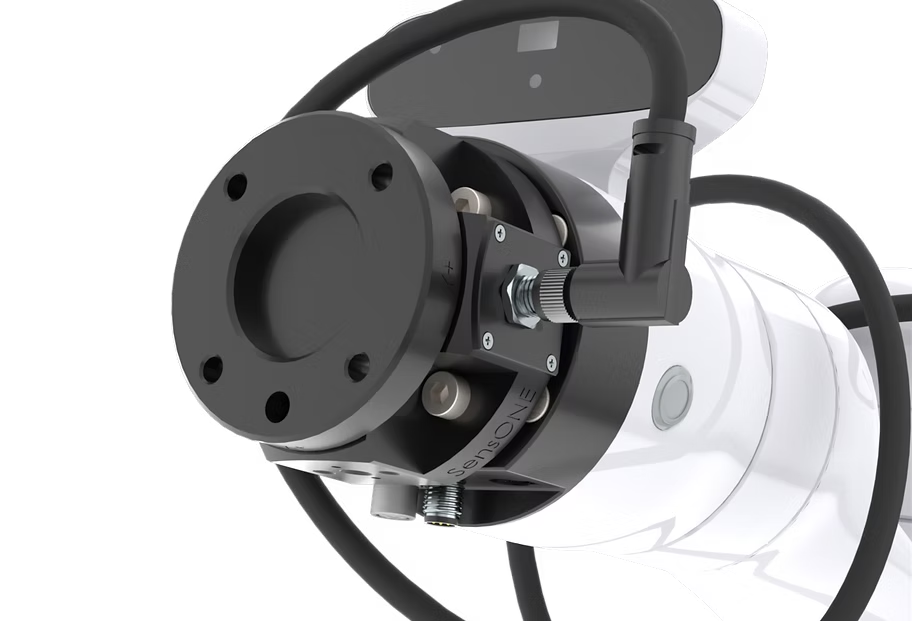


This collaboration aims to accelerate robotic developers to bridge the Sim-to-Real gap with the multimodal interaction sensing from Bota Systems
Driving Innovation in Robotic Learning
As artificial intelligence continues to transform industries, the underexplored modalities of force-torque data offer unprecedented opportunities for advancing robotic learning. This collaboration will empower research labs to efficiently gather and analyze force-torque, inertial and temperature data, paving the way for novel AI applications.
The Gen 3 robotic manipulator, a lightweight and portable platform, when integrated with the highly accurate and multimodal SensONE T15 sensor from Bota Systems, creates a seamless and powerful solution for experimentation. This setup enables researchers to explore end-to-end learning solutions, unlocking possibilities for both academic breakthroughs and industrial advancements.
Ease of Access and Integration
Robotic developers can now order the complete kit directly from Kinova, which includes the SensONE T15 sensor by Bota Systems. Designed for simplicity, the integration process is streamlined, taking just minutes to set up. Developers can access Python and C++ interfaces, along with demo code, through the online repositories of both Bota Systems and Kinova, ensuring rapid adoption and ease of use.
Not even a week after the keynote speech of NVIDIA CEO Jensen Huang, talking about Physical AI, Bota Systems a leader in robotic sensing technology, is excited to announce a new partnership aimed at empowering researchers and innovators in the robotics industry. This collaboration will combine cutting-edge force-torque (F/T) sensing technology with a lightweight and portable robotic manipulator, creating an advanced platform for exploring the next frontier in artificial intelligence: the Force Sensing.
“By bringing accurate force sensing into focus, we’re unlocking a new dimension of robotic intelligence. We believe this partnership will accelerate research and inspire innovative solutions that will shape the future of robotics,” said the CEO of Bota Systems, Klajd Lika.
Rodolphe Rosset, Sales Director, Research and Academic at Kinova, said: “While our Gen3 robot already has a built-in torque sensor, adding the Bota sensor takes its precision and sensitivity to a whole new level – meeting the demands from research laboratories for higher precision and higher sensitivity.”
About Bota Systems
Bota Systems is a developer and manufacturer of multi-axis force-torque sensors, torque sensors, and custom sensors. Founded in 2020 as a spin-off from ETH Robotic Systems Lab, Bota Systems is based in Zurich, Switzerland. Its sensors give machines the sense of touch, and the company’s vision is for robots to work and move safely, and as naturally and freely as humans. Bota Systems’ team of accomplished robotic, software, and mechanical engineers continually develops highly-integrated and advanced sensors to support a wide range of applications, across both research and industry. See www.botasys.com


